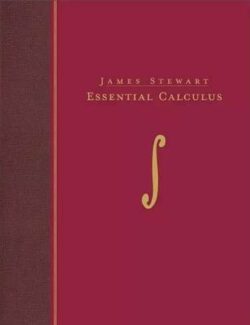
Cálculo Conceptos y Contextos – James Stewart – 5ta Edición
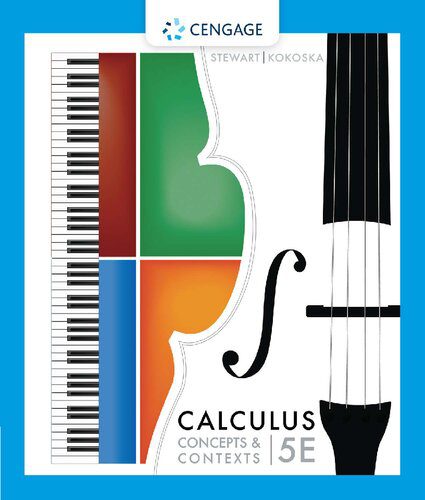
Descripción
Descubra el poder de aprender cálculo con el enfoque intuitivo, basado en el descubrimiento y de resolución de problemas que se encuentra en CALCULUS: CONCEPTS AND CONTEXTS, 5.ª edición de Stewart & Kokoska. Es una edición actualizada y fácil de leer, está diseñada utilizando los últimos principios de aprendizaje para eliminar las barreras típicas al aprendizaje. La experiencia de aprendizaje inclusivo y cuidadosamente planificada proporciona nuevas explicaciones guiadas paso a paso y ejemplos detallados con soluciones ampliadas.
Numerosos ejercicios brindan oportunidades para practicar, revisar y descubrir conceptos mediante el reconocimiento de patrones. Además, las definiciones precisas, las nuevas notas al margen y las funciones de aprendizaje se centran en conceptos clave y demuestran cómo evitar errores comunes. Cada aspecto de esta edición está diseñado para ayudarlo a comprender los conceptos más importantes de cálculo y aprender a aplicarlos en situaciones del mundo real.
Chapter 1: Functions and Models
1.1 Four Ways to Represent a Function
1.2 Mathematical Models: A Catalog of Essential Functions
1.3 New Functions from Old Functions
1.4 Exponential Functions
1.5 Inverse Functions and Logarithms
1.6 Parametric Curves
1 Review
Chapter 2: Limits
2.1 The Tangent and Velocity Problems
2.2 The Limit of a Function
2.3 Calculating Limits Using the Limit Laws
2.4 Continuity
2.5 Limits Involving Infinity
2.6 Derivatives and Rates of Change
2.7 The Derivative as a Function
2 Review
Chapter 3: Differentiation Rules
3.1 Derivatives of Polynomials and Exponential Functions
3.2 The Product and Quotient Rules
3.3 Derivatives of Trigonometric Functions
3.4 The Chain Rule
3.5 Implicit Differentiation
3.6 Inverse Trigonometric Functions and Their Derivatives
3.7 Derivatives of Logarithmic Functions
3.8 Rates of Change in the Natural and Social Sciences
3.9 Linear Approximations and Differentials
3 Review
Chapter 4: Applications of Differentiation
4.1 Related Rates
4.2 Maximum and Minimum Values
4.3 Derivatives and the Shapes of Curves
4.4 Graphing with Calculus and Technology
4.5 Indeterminate Forms and L'Hospital's Rule
4.6 Optimization Problems
4.7 Newton's Method
4.8 Antiderivatives
4 Review
Chapter 5: Integrals
5.1 Areas and Distances
5.2 The Definite Integral
5.3 Evaluating Definite Integrals
5.4 The Fundamental Theorem of Calculus
5.5 The Substitution Rule
5.6 Integration by Parts
5.7 Additional Techniques of Integration
5.8 Integration Using Tables and Computer Algebra Systems
5.9 Approximate Integration
5.10 Improper Integrals
5 Review
Chapter 6: Applications of Integration
6.1 More about Areas
6.2 Volumes
6.3 Volumes by Cylindrical Shells
6.4 Arc Length
6.5 Average Value of a Function
6.6 Applications to Physics and Engineering
6.7 Applications to Economics and Biology
6.8 Probability
6 Review
Chapter 7: Differential Equations
7.1 Modeling with Differential Equations
7.2 Slope Fields and Euler's Method
7.3 Separable Equations
7.4 Exponential Growth and Decay
7.5 The Logistic Equation
7.6 Predator-Prey Systems
7 Review
Chapter 8: Infinite Sequences and Series
8.1 Sequences
8.2 Series
8.3 The Integral and Comparison Tests, Estimating Sums
8.4 Other Convergence Tests
8.5 Power Series
8.6 Representations of Functions as Power Series
8.7 Taylor and Maclaurin Series
8.8 Applications of Taylor Polynomials
8 Review
Chapter 9: Vectors and the Geometry of Space
9.1 Three-Dimensional Coordinate Systems
9.2 Vectors
9.3 The Dot Product
9.4 The Cross Product
9.5 Equations of Lines and Planes
9.6 Functions and Surfaces
9.7 Cylindrical and Spherical Coordinates
9 Review
Chapter 10: Vector Functions
10.1 Vector Functions and Space Curves
10.2 Derivatives and Integrals of Vector Functions
10.3 Arc Length and Curvature
10.4 Motion in Space: Velocity and Acceleration
10.5 Parametric Surfaces
10 Review
Chapter 11: Partial Derivatives
11.1 Functions of Several Variables
11.2 Limits and Continuity
11.3 Partial Derivatives
11.4 Tangent Planes and Linear Approximations
11.5 The Chain Rule
11.6 Directional Derivatives and the Gradient Vector
11.7 Maximum and Minimum Values
11.8 Lagrange Multipliers
11 Review
Chapter 12: Multiple Integrals
12.1 Double Integrals over Rectangles
12.2 Iterated Integrals
12.3 Double Integrals over General Regions
12.4 Double Integrals in Polar Coordinates
12.5 Applications of Double Integrals
12.6 Surface Area
12.7 Triple Integrals
12.8 Triple Integrals in Cylindrical and Spherical Coordinates
12.9 Change of Variables in Multiple Integrals
12 Review
Chapter 13: Vector Calculus
13.1 Vector Fields
13.2 Line Integrals
13.3 The Fundamental Theorem for Line Integrals
13.4 Green's Theorem
13.5 Curl and Divergence
13.6 Surface Integrals
13.7 Stokes' Theorem
13.8 The Divergence Theorem
13.9 Summary
13 Review
Appendixes
Appendix A: Intervals, Inequalities, and Absolute Values
Appendix B: Coordinate Geometry
Appendix C: Trigonometry
Appendix D: Precise Definitions of Limits
Appendix E: A Few Proofs
Appendix F: Sigma Notation
Appendix G: Integration of Rational Functions by Partial Fractions
Appendix H: Polar Coordinates
Appendix I: Complex Numbers
Appendix J: Answers to Odd-Numbered Exercises
Index
Consulta los datos bibliográficos de esta edición para identificar correctamente el recurso, revisar su autoría y verificar detalles como ISBN, tema, subtema, archivo e idioma.
- Título: Cálculo : Conceptos y Contextos
- Autor/es: James Stewart
- Edición: 5ta Edición
- Año de publicación: 2023
- Tipo de archivo: eBook
- Idioma: eBook en Inglés
- Editorial: Cengage Learning
- ISBN-10: 0357632494
- ISBN-13: 9780357632499
- Subtema: Cálculo Fundamental
Citar este libro
Preparando citaciones...


Aún no hay comentarios
Sé el primero en compartir tu opinión sobre este contenido.
Escribir un comentario