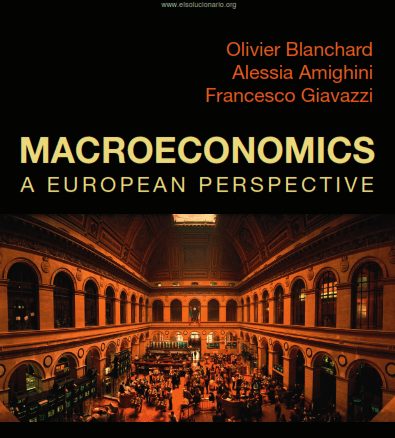
Macroeconomics: A European Perspective – Blanchard, Amighini & Giavazzi – 1st Edition
Descripción
Macroeconomics: A European Perspective dará a los estudiantes una comprensión más completa de la materia y ha sido completamente actualizado para proporcionar una amplia cobertura de la actual crisis económica en Europa. Es una visión unificada de la macroeconomía ayuda a los estudiantes para hacer las conexiones entre el corto, mediano y largo plazo.
INTRODUCTION
Chapter 1. A tour of the world
1.1 Europe and the euro 3
1.2 The economic outlook in the USA 6
1.3 The largest emerging economies 10
1.4 Looking ahead 11
Chapter 2. A tour of the book
2.1 Aggregate output 16
2.2 Other major macroeconomic variables 21
2.3 Output, unemployment and the inflation rate, Okun's law and the Philips curve 27
2.4 The short run, the medium run and the long run 29
2.5 A tour of the book 30
THE SHORT RUN
Chapter 3. The goods market
3.1 The composition of GDP 43
3.2 The demand for goods 44
3.3 The determination of equilibrium output 47
3.4 Investment equals saving: an alternative way of thinking about the goods–market equilibrium 54
3.5 Is the government omnipotent? A warning 57
Chapter 4. Financial markets
4.1 The demand for money 62
4.2 Determining the interest rate: part 1 66
4.3 Determining the interest rate: part 2 70
4.4 Two alternative ways of looking at the equilibrium 76
Chapter 5. Goods and financial markets: the IS–LM model
5.1 The goods market and the IS relation 83
5.2 Financial markets and the LM relation 87
5.3 Putting the IS and the LM relations together 90
5.4 Using a policy mix 95
5.5 IS–LM and the liquidity trap 96
5.6 How does the IS–LM model fit the facts? 99
Chapter 6. The IS–LM model in an open economy
6.1 Openness in goods markets 109
6.2 Openness in financial markets 116
6.3 The IS relation in an open economy 122
6.4 The LM relation in an open economy 128
6.5 Putting goods and financial markets together in an open economy 131
Chapter 7. Output, the interest rate and the exchange rate
7.1 Increases in demand, domestic or foreign 137
7.2 Depreciation, the trade balance and output 143
7.3 Looking at dynamics: the J-curve 145
7.4 Saving, investment and the trade balance 147
7.5 The effects of policy in an open economy 151
7.6 Fixed exchange rates 152
THE MEDIUM RUN
Chapter 8. The labour market
8.1 A tour of the labour market 165
8.2 Wage determination 170
8.3 Price determination 177
8.4 The natural rate of unemployment 178
8.5 Where we go from here 182
Chapter 9. Putting all markets together: the AS–AD model
9.1 Aggregate supply 190
9.2 Aggregate demand 192
9.3 Equilibrium in the short run and in the medium run 194
9.4 The effects of a monetary expansion 197
9.5 A decrease in the budget deficit 200
9.6 An increase in the price of oil 204
9.7 Conclusions 210
Chapter 10. The Phillips curve, the natural rate of unemployment and inflation
10.1 Inflation, expected inflation and unemployment 216
10.2 The Phillips curve 217
10.3 The Phillips curve and the natural rate of unemployment in Europe 224
Chapter 11. Inflation, money growth and the real rate of interest
11.1 Output, unemployment and inflation 237
11.2 Nominal versus real interest rates 241
11.3 Nominal and real interest rates and the IS–LM model 244
11.4 The effects of money growth 245
11.5 Money growth, inflation and nominal and real interest rates 252
11.6 Disinflation 254
Chapter 12. The medium run in an open economy
12.1 The medium run 265
12.2 Exchange rate crises under fixed exchange rates 270
12.3 Exchange rate movements under flexible exchange rates 274
12.4 Choosing between exchange rate regimes 277
THE LONG RUN
Chapter 13. The facts of growth
13.1 Measuring the standard of living 287
13.2 Growth in rich countries since 1950 290
13.3 A broader look across time and space 293
13.4 Thinking about growth: a primer 296
Chapter 14. Saving, capital accumulation and output
14.1 Interactions between output and capital 305
14.2 The implications of alternative saving rates 308
14.3 Getting a sense of magnitudes 317
14.4 Physical versus human capital 320
Chapter 15. Technological progress and growth
15.1 Technological progress and the rate of growth 328
15.2 The determinants of technological progress 334
15.3 The facts of growth revisited 337
EXPECTATIONS
Chapter 16. Financial markets and expectations
16.1 Expected present discounted values 353
16.2 Bond prices and bond yields 359
16.3 The stock market and movements in stock prices 367
16.4 Risk, bubbles, fads and asset prices 374
Chapter 17. Expectations, consumption and investment
17.1 Consumption theory and the role of expectations 383
17.2 Toward a more realistic description 387
17.3 Investment 391
17.4 The volatility of consumption and investment 398
Chapter 18. Expectations, output and policy
18.1 Expectations and decisions: taking stock 406
18.2 Monetary policy, expectations and output 409
18.3 Deficit reduction, expectations and output 415
EUROPE: PAST, PRESENT AND FUTURE
Chapter 19. The euro at fourteen: was it a good idea and why is it in trouble?
19.1 The monetary history of Europe from post-war to the present day 425
19.2 Is Europe an optimal currency area? 431
19.3 The European system of central banks: structure and objectives 434
19.4 The first thirteen years of the euro (1999–2011) 439
19.5 Should the outs join? 443
Chapter 20. The crisis
20.1 From a housing problem to a financial crisis 449
20.2 The use and limits of policy 454
20.3 The slow recovery 464
Chapter 21. High debt
21.1 The government's budget constraint 472
21.2 The evolution of the debt-to-GDP ratio 476
21.3 The return from a high debt 486
SHOULD POLICY MAKERS BE RESTRAINED?
Chapter 22. Policy and policy makers: what do we know?
22.1 Uncertainty and policy 495
22.2 Expectations and policy 498
22.3 Politics and policy 503
Chapter 23. Monetary and fiscal policy rules and constraints
23.1 The optimal inflation rate 510
23.2 Monetary policy rules 514
23.3 Fiscal policy rules and constraints 523
EPILOGUE
Chapter 24. The story of macroeconomics
24.1 Keynes and the Great Depression 541
24.2 The neoclassical synthesis 541
24.3 The rational expectations critique 544
24.4 Recent developments up to the crisis 547
24.5 First lessons from the crisis 550
Appendix 1 A maths refresher 554
Appendix 2 An introduction to econometrics 559
Glossary 564
Symbols used in this book 575
Index 577
Consulta los datos bibliográficos de esta edición para identificar correctamente el recurso, revisar su autoría y verificar detalles como ISBN, tema, subtema, archivo e idioma.
- Título: Macroeconomics: A European Perspective
- Autor/es: Olivier Blanchard | Alessia Amighini | Francesco Giavazzi
- Edición: 1ra Edición
- Año de publicación: 2013
- Tipo de archivo: eBook
- Idioma: eBook en Inglés
- Editorial: Pearson Education, Limited
- Páginas: 616
- ISBN-10: 027377168X
- ISBN-13: 9780273771685
- Subtema: Macroeconomía
Citar este libro
Preparando citaciones...







Aún no hay comentarios
Sé el primero en compartir tu opinión sobre este contenido.
Escribir un comentario