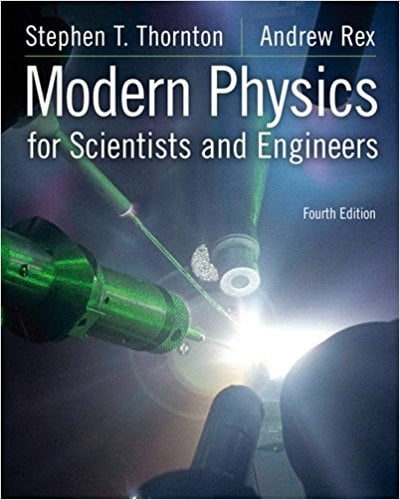
Modern Physics for Scientists and Engineers – Stephen T. Thornton, Andrew Rex – 4th Edition
Descripción
La 4ª edición de Modern Physics for Scientists and Engineers por S. Thornton y A. Rex además de contar con los últimos descubrimientos en la física moderna, presenta un enfoque moderno e integral a la física con un fuerte énfasis en las aplicaciones. Los autores discuten los experimentos que condujeron a descubrimientos importantes con el fin de ilustrar el proceso detrás de los avances científicos y para dar a los estudiantes una perspectiva histórica.
El texto cuenta con una organización flexible que permite a los instructores para seleccionar y enseñar temas en una secuencia preferida sin comprometer la experiencia de aprendizaje del estudiante. Una base teórica sólida en la teoría cuántica se incluye para ayudar a estudiantes de física a tener éxito en sus cursos de división superior.
Chapter 1: The Birth of Modern Physics
1.1: Classical Physics of the 1890s
1.2: The Kinetic Theory of Gases
1.3: Waves and Particles
1.4: Conservation Laws and Fundamental Forces
1.5: The Atomic Theory of Matter
1.6: Unresolved Questions of 1895 and New Horizons
1: Supplemental Multiple Choice Questions (10)
Chapter 2: Special Theory of Relativity
2.1: The Apparent Need for Ether
2.2: The Michelson-Morley Experiment (2)
2.3: Einstein's Postulates
2.4: The Lorentz Transformation (5)
2.5: Time Dilation and Length Contraction (4)
2.6: Addition of Velocities (4)
2.7: Experimental Verification
2.8: Twin Paradox
2.9: Spacetime
2.10: Doppler Effect (2)
2.11: Relativistic Momentum (3)
2.12: Relativistic Energy (4)
2.13: Computations in Modern Physics (2)
2.14: Electromagnetism and Relativity
2: General Problems (2)
2: Questions
2: Supplemental Multiple Choice Questions (10)
Chapter 3: The Experimental Basis of Quantum Physics
3.1: Discovery of the X Ray and the Electron (2)
3.2: Determination of Electron Charge (1)
3.3: Line Spectra (3)
3.4: Quantization
3.5: Blackbody Radiation (4)
3.6: Photoelectric Effect (5)
3.7: X-Ray Production
3.8: Compton Effect (3)
3.9: Pair Production and Annihilation
3: General Problems (1)
3: Questions
3: Supplemental Multiple Choice Questions (12)
Chapter 4: Structure of the Atom
4.1: The Atomic Models of Thomson and Rutherford
4.2: Rutherford Scattering (2)
4.3: The Classical Atomic Model
4.4: The Bohr Model of the Hydrogen Atom (4)
4.5: Successes and Failures of the Bohr Model
4.6: Characteristic X-Ray Spectra and Atomic Number (3)
4.7: Atomic Excitation by Electrons (1)
4: General Problems (3)
4: Questions
4: Supplemental Multiple Choice Questions (10)
Chapter 5: Wave Properties of Matter and Quantum Mechanics I
5.1: X-Ray Scattering (3)
5.2: De Broglie Waves (4)
5.3: Electron Scattering (3)
5.4: Wave Motion (2)
5.5: Waves or Particles?
5.6: Uncertainty Principle (4)
5.7: Probability, Wave Functions, and the Copenhagen Interpretation (1)
5.8: Particle in a Box
5: General Problems (3)
5: Questions
5: Supplemental Multiple Choice Questions (11)
Chapter 6: Quantum Mechanics II
6.1: The Schrödinger Wave Equation
6.2: Expectation Values (1)
6.3: Infinite Square-Well Potential (4)
6.4: Finite Square-Well Potential (1)
6.5: Three-Dimensional Infinite-Potential Well (1)
6.6: Simple Harmonic Oscillator (4)
6.7: Barriers and Tunneling (4)
6: General Problems (2)
6: Questions
6: Supplemental Multiple Choice Questions (10)
Chapter 7: The Hydrogen Atom
7.1: Application of the Schrödinger Equation to the Hydrogen Atom
7.2: Solution of the Schrödinger Equation for Hydrogen (1)
7.3: Quantum Numbers (4)
7.4: Magnetic Effects on Atomic Spectra—The Normal Zeeman Effect (5)
7.5: Intrinsic Spin (2)
7.6: Energy Levels and Electron Probabilities (4)
7: General Problems
7: Questions
7: Supplemental Multiple Choice Questions (10)
Chapter 8: Atomic Physics
8.1: Atomic Structure and the Periodic Table (4)
8.2: Total Angular Momentum (9)
8.3: Anomalous Zeeman Effect (3)
8: General Problems
8: Questions
8: Supplemental Multiple Choice Questions (10)
Chapter 9: Statistical Physics
9.1: Historical Overview
9.2: Maxwell Velocity Distribution
9.3: Equipartition Theorem (1)
9.4: Maxwell Speed Distribution (3)
9.5: Classical and Quantum Statistics (1)
9.6: Fermi-Dirac Statistics (3)
9.7: Bose-Einstein Statistics (1)
9: General Problems (3)
9: Questions
9: Supplemental Multiple Choice Questions (10)
Chapter 10: Molecules, Lasers, and Solids
10.1: Molecular Bonding and Spectra (4)
10.2: Stimulated Emission and Lasers (2)
10.3: Structural Properties of Solids (1)
10.4: Thermal and Magnetic Properties of Solids
10.5: Superconductivity (3)
10.6: Applications of Superconductivity (2)
10: General Problems
10: Questions
10: Supplemental Multiple Choice Questions (10)
Chapter 11: Semiconductor Theory and Devices
11.1: Band Theory of Solids
11.2: Semiconductor Theory (5)
11.3: Semiconductor Devices (2)
11.4: Nanotechnology
11: General Problems (5)
11: Questions
11: Supplemental Multiple Choice Questions (10)
Chapter 12: The Atomic Nucleus
12.1: Discovery of the Neutron
12.2: Nuclear Properties (2)
12.3: The Deuteron
12.4: Nuclear Forces (1)
12.5: Nuclear Stability (2)
12.6: Radioactive Decay (4)
12.7: Alpha, Beta, and Gamma Decay (4)
12.8: Radioactive Nuclides (4)
12: General Problems
12: Questions
12: Supplemental Multiple Choice Questions (10)
Chapter 13: Nuclear Interactions and Applications
13.1: Nuclear Reactions (3)
13.2: Reaction Kinematics (5)
13.3: Reaction Mechanisms (2)
13.4: Fission (2)
13.5: Fission Reactors (2)
13.6: Fusion
13.7: Special Applications (3)
13: General Problems
13: Questions
13: Supplemental Multiple Choice Questions (10)
Chapter 14: Particle Physics
14.1: Early Discoveries
14.2: The Fundamental Interactions (1)
14.3: Classification of Particles (1)
14.4: Conservation Laws and Symmetries (4)
14.5: Quarks (3)
14.6: The Families of Matter
14.7: Beyond the Standard Model (4)
14.8: Accelerators (3)
14: General Problems (2)
14: Questions
14: Supplemental Multiple Choice Questions (10)
Chapter 15: General Relativity
15.1: Tenets of General Relativity
15.2: Tests of General Relativity (3)
15.3: Gravitational Waves
15.4: Black Holes (2)
15.5: Frame Dragging
15: General Problems (3)
15: Questions
15: Supplemental Multiple Choice Questions (10)
Chapter 16: Cosmology and Modern Astrophysics—The Beginning and the End
16.1: Evidence of the Big Bang
16.2: The Big Bang (3)
16.3: Stellar Evolution
16.4: Astronomical Objects (4)
16.5: Problems with the Big Bang (1)
16.6: The Age of the Universe
16.7: The Standard Model of Cosmology
16.8: The Future
16: General Problems (3)
16: Questions
16: Supplemental Multiple Choice Questions (10)
Consulta los datos bibliográficos de esta edición para identificar correctamente el recurso, revisar su autoría y verificar detalles como ISBN, tema, subtema, archivo e idioma.
- Título: Modern Physics for Scientists and Engineers
- Autor/es: Andrew Rex | Stephen T. Thornton
- Edición: 3ra Edición
- Año de publicación: 2013
- Tipo de archivo: eBook | Solucionario
- Idioma: eBook en Inglés | Solucionario en Inglés
- Editorial: Cengage Learning
- Páginas: 688
- ISBN-10: 1133103723
- ISBN-13: 97811331037219781133103721
- Subtema: Física Moderna
Citar este libro
Preparando citaciones...








Aún no hay comentarios
Sé el primero en compartir tu opinión sobre este contenido.
Escribir un comentario