Thomas´ Calculus Early Transcendentals – George B. Thomas – 13th Edition
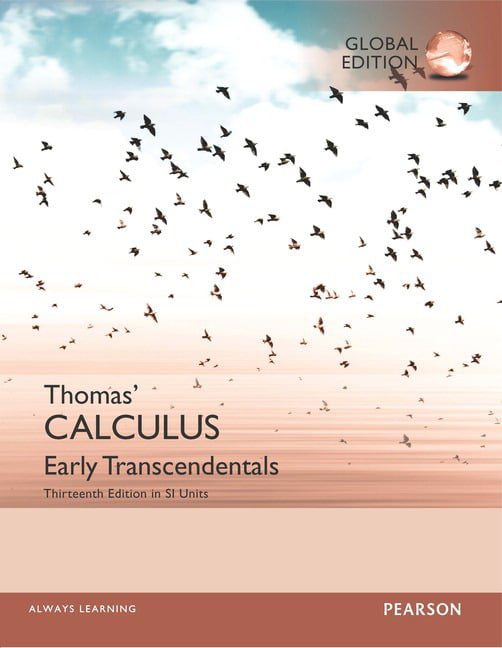
Descripción
Muchos de los estudiantes de hoy han estado expuestos a la terminología y los métodos computacionales de cálculo en la escuela secundaria. A pesar de esta familiaridad, sus habilidades de álgebra y trigonometría adquiridas a veces limitan su capacidad para dominar el cálculo a nivel universitario. En este texto, buscamos equilibrar la experiencia previa de los estudiantes en el cálculo con el desarrollo de habilidades algebraicas que aún pueden necesitar, sin ralentizar su progreso a través del propio cálculo. Nos hemos preocupado de proporcionar suficiente material de revisión $en el texto y los apéndices$, soluciones detalladas y una variedad de ejemplos y ejercicios, para respaldar una comprensión completa del cálculo para estudiantes de diferentes niveles.
Los autores presentan el material de una manera que fomenta el pensamiento de los estudiantes, yendo más allá de memorizar fórmulas y procedimientos de rutina, y nos muestran cómo generalizar conceptos clave una vez que se presentan. Se hacen referencias a lo largo de las cuales se vincula un concepto nuevo a uno relacionado que se estudió anteriormente, o a una generalización que verán más adelante. Después de estudiar el cálculo de Thomas, los estudiantes habrán desarrollado habilidades de resolución de problemas y razonamiento que les serán útiles en muchos aspectos importantes de sus vidas. Dominar este tema hermoso y creativo, con sus múltiples aplicaciones prácticas en tantos campos de esfuerzo, es su propia recompensa. Pero el verdadero don de estudiar cálculo es adquirir la capacidad de pensar de manera lógica y objetiva, y aprender a generalizar conceptualmente. Tenemos la intención de este libro para alentar y apoyar esos objetivos.
1. Functions
1.1 Functions and Their Graphs
1.2 Combining Functions; Shifting and Scaling Graphs
1.3 Trigonometric Functions
1.4 Graphing with Software
2. Limits and Continuity
2.1 Rates of Change and Tangents to Curves
2.2 Limit of a Function and Limit Laws
2.3 The Precise Definition of a Limit
2.4 One-Sided Limits
2.5 Continuity
2.6 Limits Involving Infinity; Asymptotes of Graphs
3. Differentiation
3.1 Tangents and the Derivative at a Point
3.2 The Derivative as a Function
3.3 Differentiation Rules
3.4 The Derivative as a Rate of Change
3.5 Derivatives of Trigonometric Functions
3.6 The Chain Rule
3.7 Implicit Differentiation
3.8 Related Rates
3.9 Linearization and Differentials
4. Applications of Derivatives
4.1 Extreme Values of Functions
4.2 The Mean Value Theorem
4.3 Monotonic Functions and the First Derivative Test
4.4 Concavity and Curve Sketching
4.5 Applied Optimization
4.6 Newton's Method
4.7 Antiderivatives
5. Integration
5.1 Area and Estimating with Finite Sums
5.2 Sigma Notation and Limits of Finite Sums
5.3 The Definite Integral
5.4 The Fundamental Theorem of Calculus
5.5 Indefinite Integrals and the Substitution Method
5.6 Substitution and Area Between Curves
6. Applications of Definite Integrals
6.1 Volumes Using Cross-Sections
6.2 Volumes Using Cylindrical Shells
6.3 Arc Length
6.4 Areas of Surfaces of Revolution
6.5 Work and Fluid Forces
6.6 Moments and Centers of Mass
7. Transcendental Functions
7.1 Inverse Functions and Their Derivatives
7.2 Natural Logarithms
7.3 Exponential Functions
7.4 Exponential Change and Separable Differential Equations
7.5 Indeterminate Forms and L'Hôpital's Rule
7.6 Inverse Trigonometric Functions
7.7 Hyperbolic Functions
7.8 Relative Rates of Growth
8. Techniques of Integration
8.1 Using Basic Integration Formulas
8.2 Integration by Parts
8.3 Trigonometric Integrals
8.4 Trigonometric Substitutions
8.5 Integration of Rational Functions by Partial Fractions
8.6 Integral Tables and Computer Algebra Systems
8.7 Numerical Integration
8.8 Improper Integrals
8.9 Probability
9. First-Order Differential Equations
9.1 Solutions, Slope Fields, and Euler's Method
9.2 First-Order Linear Equations
9.3 Applications
9.4 Graphical Solutions of Autonomous Equations
9.5 Systems of Equations and Phase Planes
10. Infinite Sequences and Series
10.1 Sequences
10.2 Infinite Series
10.3 The Integral Test
10.4 Comparison Tests
10.5 Absolute Convergence; The Ratio and Root Tests
10.6 Alternating Series and Conditional Convergence
10.7 Power Series
10.8 Taylor and Maclaurin Series
10.9 Convergence of Taylor Series
10.10 The Binomial Series and Applications of Taylor Series
11. Parametric Equations and Polar Coordinates
11.1 Parametrizations of Plane Curves
11.2 Calculus with Parametric Curves
11.3 Polar Coordinates
11.4 Graphing Polar Coordinate Equations
11.5 Areas and Lengths in Polar Coordinates
11.6 Conic Sections
11.7 Conics in Polar Coordinates
12. Vectors and the Geometry of Space
12.1 Three-Dimensional Coordinate Systems
12.2 Vectors
12.3 The Dot Product
12.4 The Cross Product
12.5 Lines and Planes in Space
12.6 Cylinders and Quadric Surfaces
13. Vector-Valued Functions and Motion in Space
13.1 Curves in Space and Their Tangents
13.2 Integrals of Vector Functions; Projectile Motion
13.3 Arc Length in Space
13.4 Curvature and Normal Vectors of a Curve
13.5 Tangential and Normal Components of Acceleration
13.6 Velocity and Acceleration in Polar Coordinates
14. Partial Derivatives
14.1 Functions of Several Variables
14.2 Limits and Continuity in Higher Dimensions
14.3 Partial Derivatives
14.4 The Chain Rule
14.5 Directional Derivatives and Gradient Vectors
14.6 Tangent Planes and Differentials
14.7 Extreme Values and Saddle Points14.8 Lagrange Multipliers
14.9 Taylor's Formula for Two Variables
14.10 Partial Derivatives with Constrained Variables
15. Multiple Integrals
15.1 Double and Iterated Integrals over Rectangles
15.2 Double Integrals over General Regions
15.3 Area by Double Integration
15.4 Double Integrals in Polar Form
15.5 Triple Integrals in Rectangular Coordinates
15.6 Moments and Centers of Mass
15.7 Triple Integrals in Cylindrical and Spherical Coordinates
15.8 Substitutions in Multiple Integrals
16. Integrals and Vector Fields
16.1 Line Integrals
16.2 Vector Fields and Line Integrals: Work, Circulation, and Flux
16.3 Path Independence, Conservative Fields, and Potential Functions
16.4 Green's Theorem in the Plane
16.5 Surfaces and Area
16.6 Surface Integrals
16.7 Stokes' Theorem
16.8 The Divergence Theorem and a Unified Theory
17. Second-Order Differential Equations (online)
17.1 Second-Order Linear Equations
17.2 Nonhomogeneous Linear Equations
17.3 Applications
17.4 Euler Equations
17.5 Power-Series Solutions
Appendices
1. Real Numbers and the Real Line
2. Mathematical Induction
3. Lines, Circles, and Parabolas
4. Proofs of Limit Theorems
5. Commonly Occurring Limits
6. Theory of the Real Numbers
7. Complex Numbers
8. The Distributive Law for Vector Cross Products
9. The Mixed Derivative Theorem and the Increment Theorem
Consulta los datos bibliográficos de esta edición para identificar correctamente el recurso, revisar su autoría y verificar detalles como ISBN, tema, subtema, archivo e idioma.
- Título: Thomas´ Calculus Early Transcendentals
- Autor/es: George B. Thomas | Joel R. Hass | Maurice D. Weir
- Edición: 13va Edición
- Año de publicación: 2013
- Tipo de archivo: eBook | Solucionario
- Idioma: eBook en Inglés | Solucionario en Inglés
- Editorial: Pearson
- Páginas: 1200
- ISBN-10: 0321884078
- ISBN-13: 9780321884077
- Subtema: Cálculo Integral | Cálculo Diferencial | Cálculo Fundamental | Cálculo Multivariable
Citar este libro
Preparando citaciones...



Aún no hay comentarios
Sé el primero en compartir tu opinión sobre este contenido.
Escribir un comentario