Calculus: Early Transcendentals – Jon Rogawski – 2nd Edition
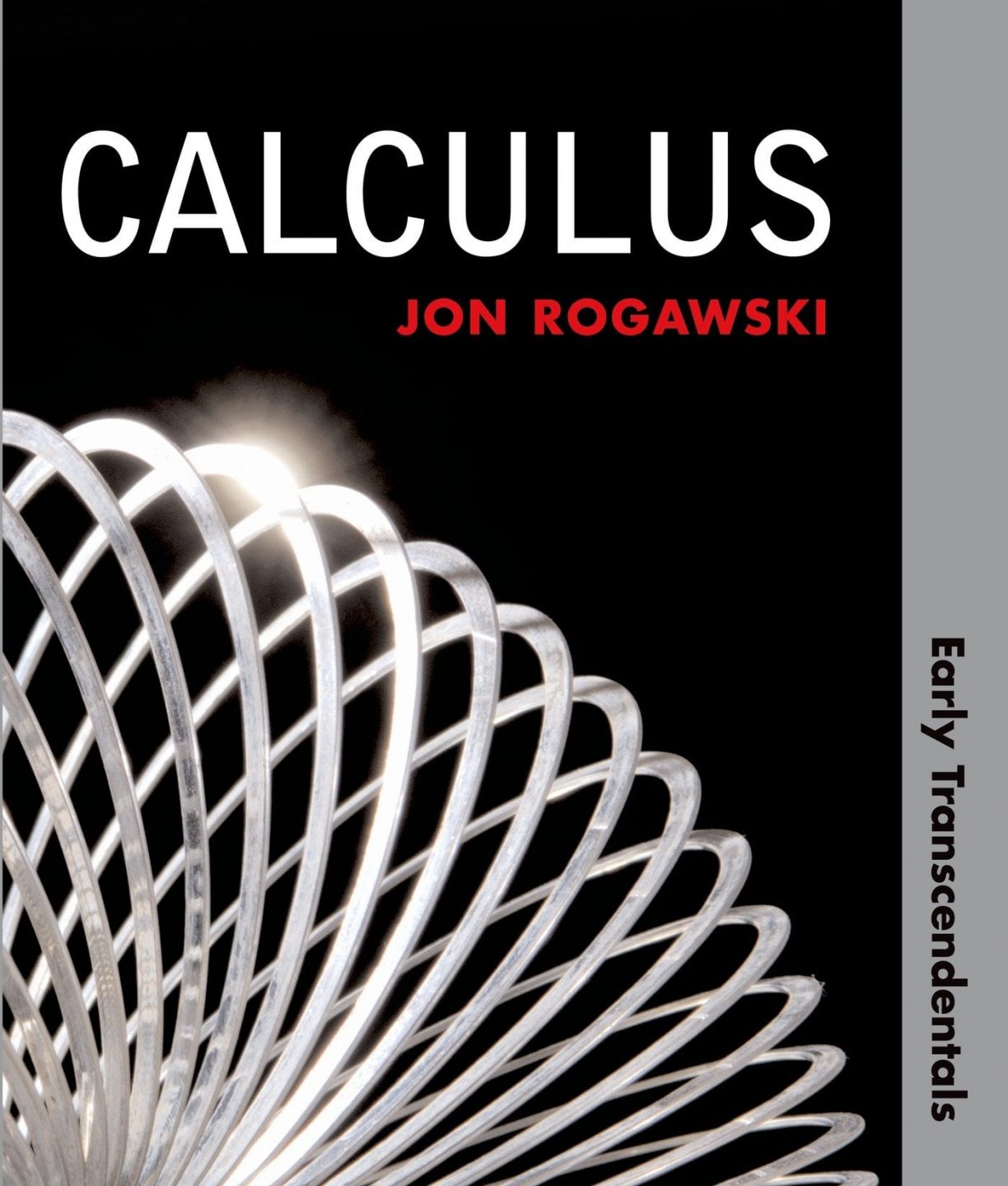
Descripción
Cálculo de Rogawski trabajó para que tanto los instructores como los estudiantes obtuvieran el equilibrio y precisión formal con un enfoque conceptual de referencia. Rogawski involucra a los estudiantes en el contexto, al tiempo que refuerza la importancia del cálculo de la vida y los estudios futuros.
Con unas matemáticas precisas, ejemplos vivos, coloridos gráficos, explicaciones intuitivas y extraordinarios problemas conjuntos, trabajan en unión para ayudar a los estudiantes a tener una comprensión más profunda de cálculo.
Chapter 1: Precalculus Review
1.1 Real Numbers, Functions, and Graphs
1.2 Linear and Quadratic Functions
1.3 The Basic Classes of Functions
1.4 Trigonometric Functions
1.5 Inverse Functions
1.6 Exponential and Logarithmic Functions
1.7 Technology Calculators and Computers
Chapter 2: Limits2.1 Limits, Rates of Change, and Tangent Lines
2.2 Limits: A Numerical and Graphical Approach2.3 Basic Limit Laws
2.4 Limits and Continuity
2.5 Evaluating Limits Algebraically
2.6 Trigonometric Limits
2.7 Limits at Infinity
2.8 Intermediate Value Theorem
2.9 The Formal Definition of a Limit
Chapter 3: Differentiation
3.1 Definition of the Derivative
3.2 The Derivative as a Function
3.3 Product and Quotient Rules
3.4 Rates of Change
3.5 Higher Derivatives
3.6 Trigonometric Functions
3.7 The Chain Rule
3.8 Derivatives of Inverse Functions
3.9 Derivatives of General Exponential and Logarithmic Functions
3.10 Implicit Differentiation
3.11 Related Rates
Chapter 4: Applications of the Derivative
4.1 Linear Approximation and Applications
4.2 Extreme Values
4.3 The Mean Value Theorem and Monotonicity
4.4 The Shape of a Graph
4.5 L'Hopital's Rule
4.6 Graph Sketching and Asymptotes
4.7 Applied Optimization
4.8 Newton's Method
4.9 Antiderivatives
Chapter 5: The Integral
5.1 Approximating and Computing Area
5.2 The Definite Integral
5.3 The Fundamental Theorem of Calculus, Part I
5.4 The Fundamental Theorem of Calculus, Part II
5.5 Net Change as the Integral of a Rate
5.6 Substitution Method
5.7 Further Transcendental Functions
5.8 Exponential Growth and Decay
Chapter 6: Applications of the Integral
6.1 Area Between Two Curves
6.2 Setting Up Integrals: Volume, Density, Average Value
6.3 Volumes of Revolution
6.4 The Method of Cylindrical Shells
6.5 Work and Energy
Chapter 7: Techniques of Integration
7.1 Integration by Parts
7.2 Trigonometric Integrals
7.3 Trigonometric Substitution
7.4 Integrals Involving Hyperbolic and Inverse Hyperbolic Functions
7.5 The Method of Partial Fractions
7.6 Improper Integrals
7.7 Probability and Integration
7.8 Numerical Integration
Chapter 8: Further Applications of the Integral and Taylor Polynomials
8.1 Arc Length and Surface Area
8.2 Fluid Pressure and Force
8.3 Center of Mass
8.4 Taylor Polynomials
Chapter 9: Introduction to Differential Equations
9.1 Solving Differential Equations
9.2 Models Involving y' = k (y-b)
9.3 Graphical and Numerical Methods
9.4 The Logistic Equation
9.5 First-Order Linear Equations
Chapter 10: Infinite Series
10.1 Sequences
10.2 Summing an Infinite Series
10.3 Convergence of Series with Positive Terms
10.4 Absolute and Conditional Convergence
10.5 The Ratio and Root Tests
10.6 Power Series
10.7 Taylor Series
Chapter 11: Parametric Equations, Polar Coordinates, and Conic Sections
11.1 Parametric Equations
11.2 Arc Length and Speed
11.3 Polar Coordinates
11.4 Area and Arc Length in Polar Coordinates
11.5 Conic Sections
Chapter 12: Vector Geometry
12.1 Vectors in the Plane
12.2 Vectors in Three Dimensions
12.3 Dot Product and the Angle Between Two Vectors
12.4 The Cross Product
12.5 Planes in Three-Space
12.6 A Survey of Quadric Surfaces
12.7 Cylindrical and Spherical Coordinates
Chapter 13: Calculus of Vector-Valued Functions
13.1 Vector-Valued Functions
13.2 Calculus of Vector-Valued Functions
13.3 Arc Length and Speed
13.4 Curvature
13.5 Motion in Three-Space
13.6 Planetary Motion According to Kepler and Newton
Chapter 14: Differentiation in Several Variables
14.1 Functions of Two or More Variables
14.2 Limits and Continuity in Several Variables
14.3 Partial Derivatives
14.4 Differentiability and Tangent Planes
14.5 The Gradient and Directional Derivatives
14.6 The Chain Rule
14.7 Optimization in Several Variables
14.8 Lagrange Multipliers: Optimizing with a Constraint
Chapter 15: Multiple Integration
15.1 Integration in Variables
15.2 Double Integrals over More General Regions
15.3 Triple Integrals
15.4 Integration in Polar, Cylindrical, and Spherical Coordinates
15.5 Applications of Multiplying Integrals
15.6 Change of Variables
Chapter 16: Line and Surface Integrals
16.1 Vector Fields
16.2 Line Integrals
16.3 Conservative Vector Fields
16.4 Parametrized Surfaces and Surface Integrals
16.5 Surface Integrals of Vector Fields
Chapter 17: Fundamental Theorems of Vector Analysis
17.1 Green's Theorem
17.2 Stokes' Theorem
17.3 Divergence Theorem
Appendices
A. The Language of Mathematics
B. Properties of Real Numbers
C. Mathematical Induction and the Binomial Theorem
D. Additional Proofs of Theorems
E. Taylor Polynomials
Consulta los datos bibliográficos de esta edición para identificar correctamente el recurso, revisar su autoría y verificar detalles como ISBN, tema, subtema, archivo e idioma.
- Título: Calculus : Early Transcendentals
- Autor/es: Jon Rogawski
- Edición: 2da Edición
- Año de publicación: 2012
- Volumen: Volumen 1 | Volumen 2
- Tipo de archivo: eBook | Solucionario
- Idioma: eBook en Inglés | Solucionario en Inglés
- Editorial: W.H. Freeman
- Páginas: 1044
- ISBN-10: 1429208384
- ISBN-13: 9781429208383
- Subtema: Cálculo Diferencial | Cálculo Fundamental | Cálculo Integral | Cálculo Multivariable
Citar este libro
Preparando citaciones...




Aún no hay comentarios
Sé el primero en compartir tu opinión sobre este contenido.
Escribir un comentario