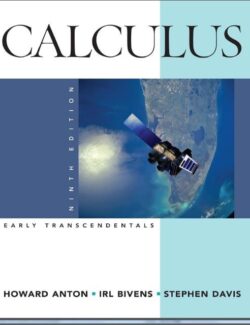
Calculus – Howard Anton, Irl Bivens, Stephen Davis – 10th Edition
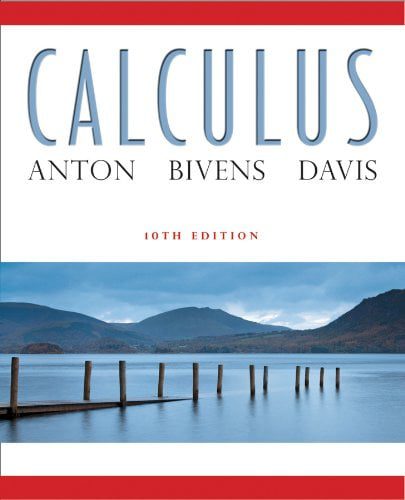
Descripción
Cálculo, la Décima Edición de Howard Anton; continúa evolucionando para satisfacer las necesidades de un mercado cambiante al proporcionar soluciones flexibles a las necesidades de enseñanza y aprendizaje de todo tipo. Cálculo, Décima edición sobresale en aumentar la comprensión de los estudiantes y la comprensión conceptual de las matemáticas.
Los libros de Anton son libros de cálculo tradicional con teoremas formales y explicaciones de los antecedentes teóricos de cómo funciona el cálculo. La cobertura es ascendente a través del cálculo vectorial, derivadas parciales y múltiples integrales. Ya que hay tantos libros de cálculo y la cobertura en ellos es muy similar, pero podemos decir que este libro es sobresaliente. Es ciertamente mejor que el promedio y lo recomendamos para su uso en el riguroso curso de primer semestre de cálculo.
La nueva edición conserva los puntos fuertes de las ediciones anteriores: por ejemplo, la claridad de exposición de la marca registrada de Anton; Matemáticas sanas; Excelentes ejercicios y ejemplos; y el nivel apropiado, al tiempo que incorpora más problemas de habilidad; continúa la visión de Anton de fomentar la confianza de los estudiantes en las matemáticas, ya que elimina las conjeturas de los estudios proporcionándoles una Hoja de ruta clara: qué hacer, cómo hacerlo y si lo hicieron bien.
1. FUNCTIONS
1.1 Functions
1.2 Graphing Functions Using Calculators and Computer Algebra Systems
1.3 New Functions from Old
1.4 Families of Functions4
1.5 Inverse Functions; Inverse Trigonometric Functions
1.6 Exponential and Logarithmic Functions
1.7 Mathematical Models
1.8 Parametric Equations
2. LIMITS AND CONTINUITY
2.1 Limits (An Intuitive Approach)
2.2 Computing Limits
2.3 Limits at Infinity; End Behavior of a Function
2.4 Limits (Discussed More Rigorously)
2.5 Continuity
2.6 Continuity of Trigonometric and Inverse Functions
3. THE DERIVATIVE
3.1 Tangent Lines, Velocity, and General Rates of Change
3.2 The Derivative Function
3.3 Techniques of Differentiation9
3.4 The Product and Quotient Rules
3.5 Derivatives of Trigonometric Functions
3.6 The Chain Rule
3.7 Related Rates
3.8 Local Linear Approximation; Differentials
4. EXPONENTIAL, LOGARITHMIC, AND INVERSE TRIGONOMETRIC FUNCTIONS
4.1 Implicit Differentiation
4.2 Derivatives of Logarithmic Functions
4.3 Derivatives of Exponential and Inverse Trigonometric Functions
4.4 L'Hôpital's Rule; Indeterminate Forms
5. THE DERIVATIVE IN GRAPHING AND APPLICATIONS
5.1 Analysis of Functions I:Increase, Decrease, and Concavity
5.2 Analysis of Functions II: Relative Extrema; Graphing Polynomials
5.3 More on Curve Sketching: Rational Functions; Curves with Cusps and Vertical Tangent Lines; Using Technology
5.4 Absolute Maxima and Minima
5.5 Applied Maximum and Minimum Problems
5.6 Newton's Method
5.7 Rolle's Theorem; Mean-Value Theorem
5.8 Rectilinear Motion
6. INTEGRATION
6.1 An Overview of the Area Problem
6.2 The Indefinite Integral
6.3 Integration by Substitution
6.4 The Definition of Area as a Limit; Sigma Notation
6.5 The Definite Integral
6.6 The Fundamental Theorem of Calculus
6.7 Rectilinear Motion Revisited Using Integration
6.8 Evaluating Definite Integrals by Substitution
6.9 Logarithmic Functions from the Integral Point of View
7. APPLICATIONS OF THE DEFINITE INTEGRAL IN GEOMETRY, SCIENCE, AND ENGINEERING
7.1 Area Between Two Curves
7.2 Volumes by Slicing; Disks and Washers5
7.3 Volumes by Cylindrical Shells
7.4 Length of a Plane Curve
7.5 Area of a Surface of Revolution
7.6 Average Value of a Function and its Applications
7.7 Work
7.8 Fluid Pressure and Force9
7.9 Hyperbolic Functions and Hanging Cables
8. PRINCIPLES OF INTEGRAL EVALUATION
8.1 An Overview of Integration Methods
8.2 Integration by Parts
8.3 Trigonometric Integrals
8.4 Trigonometric Substitutions3
8.5 Integrating Rational Functions by Partial Fractions
8.6 Using Computer Algebra Systems and Tables of Integrals
8.7 Numerical Integration; Simpson's Rule
8.8 Improper Integrals
9. MATHEMATICAL MODELING WITH DIFFERENTIAL EQUATIONS
9.1 First-Order Differential Equations and Applications
9.2 Slope Fields; Euler's Method
9.3 Modeling with First-Order Differential Equations
9.4 Second-Order Linear Homogeneous Differential Equations; The Vibrating Spring
10. INFINITE SERIES
10.1 Sequences
10.2 Monotone Sequences
10.3 Infinite Series
10.4 Convergence Tests
10.5 The Comparison, Ratio, and Root Tests
10.6 Alternating Series; Conditional Convergence
10.7 Maclaurin and Taylor Polynomials
10.8 Maclaurin and Taylor Series; PowerSeries
10.9 Convergence of Taylor Series
10.10 Differentiating and Integrating Power Series; Modeling with Taylor Series
11. ANALYTIC GEOMETRY IN CALCULUS
11.1 Polar Coordinates
11.2 Tangent Lines and Arc Length for Parametric and Polar Curves
11.3 Area in Polar Coordinates4
11.4 Conic Sections in Calculus
11.5 Rotation of Axes; Second-Degree Equations
11.6 Conic Sections in Polar Coordinates
Horizon Module: Comet Collision
12. THREE-DIMENSIONAL SPACE; VECTORS
12.1 Rectangular Coordinates in-Space; Spheres; Cylindrical Surfaces
12.2 Vectors
12.3 Dot Product; Projections
12.4 Cross Product
12.5 Parametric Equations of Lines
12.6 Planes in-Space
12.7 Quadric Surfaces
12.8 Cylindrical and Spherical Coordinates5
13. VECTOR-VALUED FUNCTIONS
13.1 Introduction to Vector-Valued Functions
13.2 Calculus of Vector-Valued Functions
13.3 Change of Parameter; Arc Length
13.4 Unit Tangent, Normal, and Binormal Vectors
13.5 Curvature
13.6 Motion Along a Curve
13.7 Kepler's Laws of Planetary Motion
14. PARTIAL DERIVATIVES
14.1 Functions of Two or More Variables
14.2 Limits and Continuity
14.3 Partial Derivatives
14.4 Differentiability, Differentials, and Local Linearity
14.5 The Chain Rule
14.6 Directional Derivatives and Gradients
14.7 Tangent Planes and Normal Vectors
14.8 Maxima and Minima of Functions of Two Variables
14.9 Lagrange Multipliers
15. MULTIPLE INTEGRALS
15.1 Double Integrals
15.2 Double Integrals over Nonrectangular Regions
15.3 Double Integrals in Polar Coordinates
15.4 Parametric Surfaces; Surface Area
15.5 Triple Integrals
15.6 Centroid, Center of Gravity, Theorem of Pappus
15.7 Triple Integrals in Cylindrical and Spherical Coordinates
15.8 Change of Variables in Multiple Integrals; Jacobians
16. TOPICS IN VECTOR CALCULUS
16.1 Vector Fields
16.2 Line Integrals
16.3 Independence of Path; Conservative Vector Fields
16.4 Green's Theorem
16.5 Surface Integrals
16.6 Applications of Surface Integrals; Flux
16.7 The Divergence Theorem
16.8 Stokes' Theorem
Consulta los datos bibliográficos de esta edición para identificar correctamente el recurso, revisar su autoría y verificar detalles como ISBN, tema, subtema, archivo e idioma.
- Título: Calculus : Early Transcendentals
- Autor/es: Howard Anton | Irl Bivens | Stephen Davis
- Edición: 10ma Edición
- Año de publicación: 2012
- Tipo de archivo: Solucionario | eBook
- Idioma: eBook en Inglés | Solucionario en Inglés
- Editorial: Wiley & Sons, Incorporated, John
- ISBN-10: 1118404009
- ISBN-13: 9781118404003
- Subtema: Cálculo Multivariable | Cálculo Diferencial | Cálculo Fundamental | Cálculo Integral
Citar este libro
Preparando citaciones...





Aún no hay comentarios
Sé el primero en compartir tu opinión sobre este contenido.
Escribir un comentario