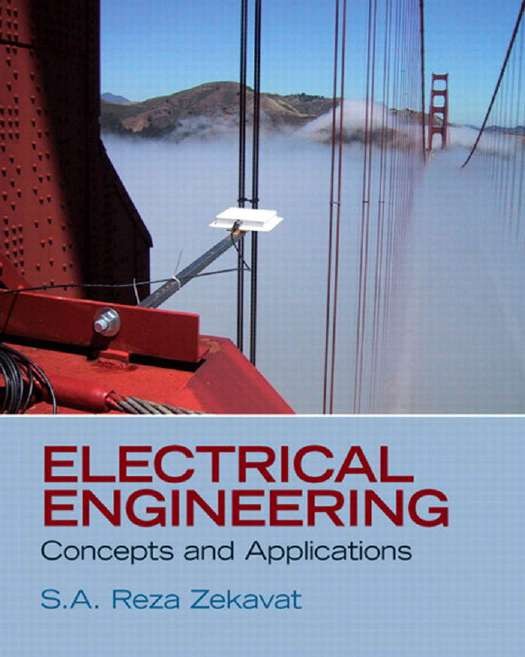
Electrical Engineering: Concepts and Applications – S. A. Reza Zekavat – 1st Edition
Descripción
Este libro nace con la misión de servir como un texto introductorio moderno de ingeniería eléctrica no solo para los alumnos de ingeniería eléctrica, sino también para estudiantes de otras ramas que necesitan comprender la disciplina eléctrica de forma clara, motivadora y aplicada. Según el autor, el texto fue el resultado de un esfuerzo multidisciplinario en la Michigan Technological University para desarrollar un currículo que fuera atractivo, relevante y útil para estudiantes de ingeniería general. :contentReference[oaicite:3]{index=3}
Desde el prefacio se afirma que la ingeniería eléctrica (EE) ya no es una materia auxiliar que ocasionalmente aparece en los planes, sino una pieza clave en casi todos los sistemas de ingeniería modernos desde la energía hasta las comunicaciones, las estructuras inteligentes, los sistemas embebidos y la automoción. En ese sentido, el autor plantea que la formación en EE debe vincularse con aplicaciones reales, casos prácticos y herramientas de simulación para motivar al estudiante. :contentReference[oaicite:4]{index=4}
El libro está estructurado para que el lector avance desde los fundamentos de la electricidad y los circuitos, hacia el análisis de circuitos, componentes, magnetismo, electrónica, sistemas de potencia, lógica digital y electromecánica. Pero lo hace siempre con un enfoque aplicado: cada capítulo incluye problemas finales, ejemplos de software (como PSpice y MATLAB®) y estudios de caso extraídos de diferentes ramas de la ingeniería. Por ejemplo, en el Capítulo 1 se presentan situaciones laborales reales (on-the-job situations) en control estructural activo, control de procesos químicos y prototipo de vehículo todoterreno para motivar el tema antes de introducir la teoría. :contentReference[oaicite:5]{index=5}
El texto es especialmente adecuado para estudiantes de ingeniería que no son de la especialidad eléctrica mecánica, civil, química, ambiental y que necesitan adquirir una base sólida en ingeniería eléctrica sin perder la relevancia de su propia especialidad. Para ingenieros eléctricos que inician su formación o como repaso, también es útil. La combinación de teoría, ejemplos prácticos, simulación y problemas hace que también sea adecuada para autodidactas o profesionales de otras disciplinas que requieran una base en EE.
Los aspectos más destacados del contenido incluyen:
- Gran cantidad de ejemplos basados en aplicaciones reales: cada capítulo presenta cómo los conceptos de EE se aplican en distintos campos de la ingeniería. :contentReference[oaicite:6]{index=6}
- Integración de herramientas de simulación en los capítulos (PSpice, MATLAB) para facilitar que el estudiante no solo entienda la teoría, sino que también practique con software. :contentReference[oaicite:7]{index=7}
- Tratamiento claro y progresivo de circuitos eléctricos: desde la ley de Ohm, leyes de Kirchhoff, análisis nodal/malla, hasta temas de potencia, transformadores, máquinas eléctricas y lógica digital. :contentReference[oaicite:8]{index=8}
En resumen, Electrical Engineering: Concepts and Applications es una obra moderna para introducir la ingeniería eléctrica en un contexto de ingeniería general, combinando fundamentos, aplicaciones y herramientas de simulación. Para tu catálogo, representa una excelente adición como libro de base para cursos de introducción a EE o como texto de referencia para ingenieros de otras disciplinas que necesitan comprender sistemas eléctricos.
Preface
Acknowledgements
Chapter 1: Why Electrical Engineering?
- Introduction
- Electrical Engineering and a Successful Career
- What Do You Need to Know about EE?
- Real Career Success Stories
- Typical Situations Encountered on the Job
- Further Reading
Chapter 2: Fundamentals of Electric Circuits
- Introduction
- Charge and Current
- Voltage
- Respective Direction of Voltage and Current
- Kirchhoffs Current Law
- Kirchhoffs Voltage Law
- Ohms Law and Resistors
- Resistivity of a Resistor
- Nonlinear Resistors
- Time?Varying Resistors
- Power and Energy
- Resistor?Consumed Power
- Independent and Dependent Sources
- Analysis of Circuits Using PSpice
- Bias Point Analysis
- Time Domain (Transient) Analysis
- What Did You Learn?
Chapter 3: Resistive Circuits
- Introduction
- Resistors in Parallel and Series
- Equivalent Resistance
- Voltage Division
- Current Division
- Nodal Analysis
- Mesh Analysis
- Super Node
- Thévenin/Norton Equivalent Circuits
- Source Transformation
- Superposition Principle
- Maximum Power Transfer
- Analysis of Circuits Using PSpice
- What Did You Learn?
Chapter 4: Capacitance and Inductance
- Introduction
- Capacitors
- ChargeVoltageCurrent Relationship
- Power and Energy in Capacitors
- Capacitors in Series
- Capacitors in Parallel
- Inductors
- VoltageCurrent Relationship in Inductors
- Power and Stored Energy
- Inductors in Series
- Inductors in Parallel
- Applications of Capacitors and Inductors
- Analysis of Capacitive and Inductive Circuits Using PSpice
- What Did You Learn?
Chapter 5: Transient Analysis
- Introduction
- First?Order Circuits
- RC Circuits
- RL Circuits
- DC Steady State
- CapacitiveInductive Steady State
- Second?Order Circuits
- Series RLC Circuits
- Parallel RLC Circuits
- Transient Analysis with Sinusoidal Forcing
- Using PSpice
- What Did You Learn?
Chapter 6: Steady?State AC Analysis
- Introduction: Sinusoidal Voltages and Currents
- RMS Values
- Instantaneous and Average Power
- Phasors
- Impedances
- Steady?State Circuit Analysis Using Phasors
- Thévenin and Norton Equivalents with Phasors
- AC Steady?State Power
- Power Factor
- Complex Power and Apparent Power
- Maximum Power Transfer
- Power Factor Correction
- PSpice Analysis
- What Did You Learn?
Chapter 7: Frequency Analysis
- Introduction
- First?Order Filters
- Transfer Functions
- Low?Pass Filters
- Bode Plots
- High?Pass Filters
- Cascaded Networks
- Second?Order Filters
- Band?Pass Filters
- Band?Stop Filters
- MATLAB Applications
- Using PSpice
- What Did You Learn?
Chapter 8: Electronic Circuits
- Introduction
- P?Type and N?Type Semiconductors
- Diodes
- Diode Applications
- Types of Diodes
- AC?to?DC Converters
- Transistors
- Bipolar Junction Transistors
- Transistor as Amplifier
- Transistors as Switches
- Field?Effect Transistors
- Logic Gate Design (NMOS/CMOS)
- Operational Amplifiers
- Using PSpice
- What Did You Learn?
Chapter 9: Power Systems and Transmission Lines
- Introduction
- Three?Phase Systems
- Phase Sequence
- Y?Connected and ??Connected Loads
- StarDelta Transformations
- Power in Three?Phase Systems
- Transmission Lines
- Resistance
- Types of Conductors
- Inductance
- Capacitance
- Transmission Line Equivalent Circuits
- Using PSpice
- What Did You Learn?
Chapter 10: Fundamentals of Logic Circuits
- Introduction
- Number Systems
- Boolean Algebra
- Basic Logic Gates
- Sequential Logic Circuits
- Using PSpice
- What Did You Learn?
Chapter 11: Computer?Based Instrumentation Systems
- Introduction
- Sensors
- Signal Conditioning
- Data Acquisition
- Grounding Issues
- Using PSpice
- What Did You Learn?
Chapter 12: Principles of Electromechanics
- Introduction
- Magnetic Fields
- Magnetic Circuits
- Mutual Inductance and Transformers
- Types of Transformers
- Using PSpice
- What Did You Learn?
Chapter 13: Electric Machines
- Introduction
- DC Motors
- Types of DC Motors
- Speed Control Methods
- DC Generators
- AC Motors
- AC Generators
- Special Types of Motors
- Selecting Motors
- Using PSpice
- What Did You Learn?
Chapter 14: Electrical Measurement Instruments
- Introduction
- Measurement Errors
- Ammeters, Voltmeters, Ohmmeters
- Multimeters
- Time vs Frequency Domain
- Oscilloscope
- Spectrum Analyzer
- Function Generator
- What Did You Learn?
Chapter 15: Electrical Safety
- Introduction
- Electric Shock
- Electromagnetic Hazards
- Arcs and Explosions
- National Electric Code
- What Did You Learn?
Appendices
- Appendix A: Solving Linear Equations
- Appendix B: Laplace Transform
- Appendix C: Complex Numbers
- Selected Solutions
- Index
Consulta los datos bibliográficos de esta edición para identificar correctamente el recurso, revisar su autoría y verificar detalles como ISBN, tema, subtema, archivo e idioma.
- Título: Electrical Engineering: Concepts and Applications
- Autor/es: S. A. Reza Zekavat
- Edición: 1ra Edición
- Año de publicación: 2013
- Tipo de archivo: eBook
- Idioma: eBook en Inglés
- Editorial: Pearson Prentice Hall
- ISBN-10: 0132539187
- ISBN-13: 9780132539180
- Subtema: Ingeniería Eléctrica
Citar este libro
Preparando citaciones...

Aún no hay comentarios
Sé el primero en compartir tu opinión sobre este contenido.
Escribir un comentario