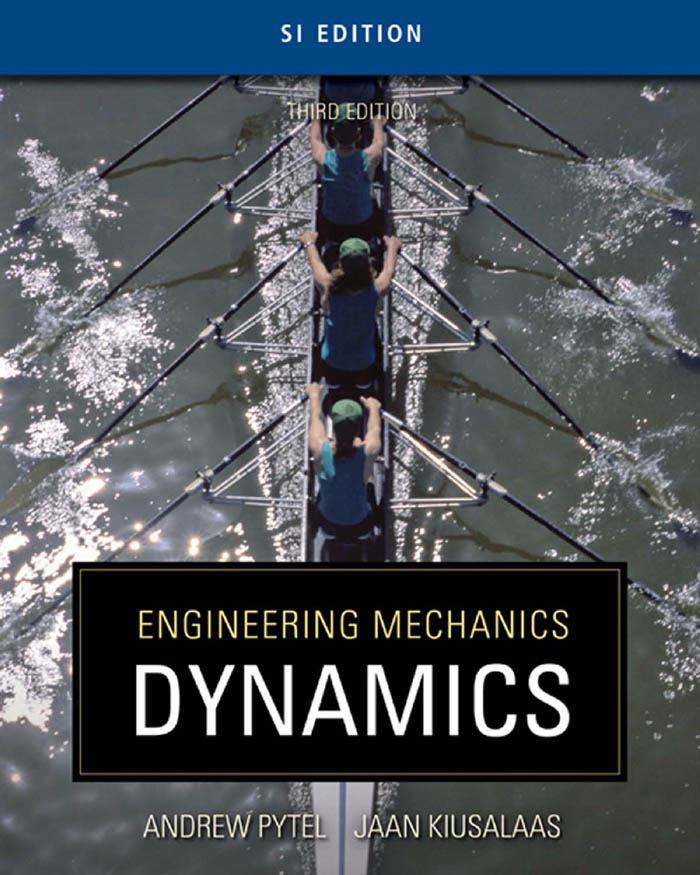
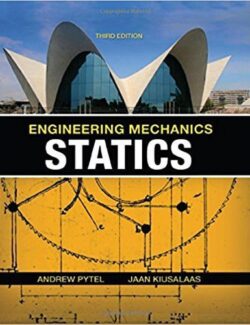
Engineering Mechanics Dynamics (SI Edition) – Andrew Pytel, Jaan Kiusalaas – 3rd Edition
Descripción
Los autores reconocidos a nivel nacional Andrew Pytel y Jaan Kiusalaas aportan una experiencia profunda que no se puede superar en esta tercera edición de Engineering Mechanics: Dynamics. Han refinado su cobertura sólida del material sin sobrecargarlo con detalles superfluos y han revisado el texto ahora de dos colores para que sea aún más conciso y apropiado para los estudiantes de ingeniería de hoy.
El texto analiza la aplicación de los fundamentos de la dinámica newtoniana y los aplica a problemas de ingeniería del mundo real. También se encuentra disponible una Guía de estudio adjunta para este texto. La primera introducción a la relación entre fuerza y ??aceleración utilizada en esta pedagogía permite a los estudiantes darse cuenta mucho antes de cómo se pueden usar las leyes del movimiento de Newton para analizar problemas.
Cuando sea apropiado, los problemas de muestra se resuelven utilizando notaciones escalares y vectoriales, lo que permite una mayor capacidad de resolución de problemas. Muchos de los problemas son nuevos o han sido revisados ??y se centran en los temas fundamentales del tema. Una guía de estudio separada diseñada específicamente para el texto contiene veintinueve lecciones, cada una de las cuales contiene una autoevaluación y problemas guiados.
Chapter 11: Introduction to Dynamics
11.1 Introduction
11.2 Derivatives of Vector Functions
11.3 Position, Velocity, and Acceleration of a Particle
11.4 Newtonian Mechanics
Review of Equations
Chapter 12: Dynamics of a Particle: Rectangular Coordinates
12.1 Introduction
12.2 Kinematics
12.3 Kinetics: Force-Mass-Acceleration Method
12.4 Dynamics of Rectilinear Motion
12.5 Curvilinear Motion
12.6 Analysis of Motion by the Area Method
Review of Equations
Review Problems
Chapter 13: Dynamics of a Particle: Curvilinear Coordinates
13.1 Introduction
13.2 KinematicsPath (Normal-Tangential) Coordinates
13.3 KinematicsPolar and Cylindrical Coordinates
13.4 Kinetics: Force-Mass-Acceleration Method
Review of Equations
Review Problems
Chapter 14: Work-Energy and Impulse-Momentum Principles for a Particle
14.1 Introduction
14.2 Work of a Force
14.3 Principle of Work and Kinetic Energy
14.4 Conservative Forces and the Conservation of Mechanical Energy
14.5 Power and Efficiency
14.6 Principle of Impulse and Momentum
14.7 Principle of Angular Impulse and Momentum
14.8 Space Motion under a Gravitational Force
Review of Equations
Review Problems
Chapter 15: Dynamics of Particle Systems
15.1 Introduction
15.2 Kinematics of Relative Motion
15.3 Kinematics of Constrained Motion
15.4 Kinetics: Force-Mass-Acceleration Method
15.5 Work-Energy Principles
15.6 Principle of Impulse and Momentum
15.7 Principle of Angular Impulse and Momentum
15.8 Plastic Impact
15.9 Impulsive Motion
15.10 Elastic Impact
15.11 Mass Flow
Review of Equations
Review Problems
Chapter 16: Planar Kinematics of Rigid Bodies
16.1 Introduction
16.2 Plane Angular Motion
16.3 Rotation about a Fixed Axis
16.4 Relative Motion of Two Points in a Rigid Body
16.5 Method of Relative Velocity
16.6 Instant Center for Velocities
16.7 Method of Relative Acceleration
16.8 Absolute and Relative Derivatives of Vectors
16.9 Motion Relative to a Rotating Reference Frame
16.10 Method of Constraints
Review of Equations
Review Problems
Chapter 17: Planar Kinetics of Rigid Bodies: Force-Mass-Acceleration Method
17.1 Introduction
17.2 Mass Moment of Inertia; Composite Bodies
17.3 Angular Momentum of a Rigid Body
17.4 Equations of Motion
17.5 Force-Mass-Acceleration Method: Plane Motion
17.6 Differential Equations of Motion
Review of Equations
Review Problems
Chapter 18: Planar Kinetics of Rigid Bodies: Work-Energy and Impulse-Momentum Methods
18.1 Introduction
Part A: Work-Energy Method
18.2 Work and Power of a Couple
18.3 Kinetic Energy of a Rigid Body
18.4 Work-Energy Principle and Conservation of Mechanical Energy
Part B: Impulse-Momentum Method
18.5 Momentum Diagrams
18.6 Impulse-Momentum Principles
18.7 Rigid-Body Impact
Review of Equations
Review Problems
Chapter 19: Rigid-Body Dynamics in Three Dimensions
19.1 Introduction
19.2 Kinematics
19.3 Impulse-Momentum Method
19.4 Work-Energy Method
19.5 Force-Mass-Acceleration Method
19.6 Motion of an Axisymmetric Body
Review of Equations
Chapter 20: Vibrations
20.1 Introduction
20.2 Free Vibrations of Particles
20.3 Forced Vibrations of Particles
20.4 Rigid-Body Vibrations
20.5 Methods Based on Conservation of Energy
Review of Equations
Review Problems
Appendix D: Proof of the Relative Velocity Equation for Rigid-Body Motion
Appendix E: Numerical Solution of Differential Equations
E.1 Introduction
E.2 Numerical Methods
E.3 Application of MATLAB
E.4 Linear Interpolation
Appendix F: Mass Moments and Products of Inertia
F.1 Introduction
F.2 Review of Mass Moment of Inertia
F.3 Moments of Inertia of Thin Plates
F.4 Mass Moment of Inertia by Integration
F.5 Mass Products of Inertia; Parallel-Axis Theorems
F.6 Products of Inertia by Integration; Thin Plates
F.7 Inertia Tensor; Moment of Inertia about an Arbitrary Axis
F.8 Principal Moments and Principal Axes of Inertia
Answers to Even-Numbered Problems
Index
Consulta los datos bibliográficos de esta edición para identificar correctamente el recurso, revisar su autoría y verificar detalles como ISBN, tema, subtema, archivo e idioma.
- Título: Engineering Mechanics Dynamics (SI Edition)
- Autor/es: Andrew Pytel | Jaan Kiusalaas
- Edición: 3ra Edición
- Año de publicación: 2010
- Tipo de archivo: eBook | Solucionario (Premium)
- Idioma: eBook en Inglés | Solucionario en Inglés
- Editorial: Nelson Engineering
- Páginas: 651
- ISBN-10: 0495295639
- ISBN-13: 9780495295631
- Subtema: Dinámica Vectorial
Citar este libro
Preparando citaciones...









Aún no hay comentarios
Sé el primero en compartir tu opinión sobre este contenido.
Escribir un comentario