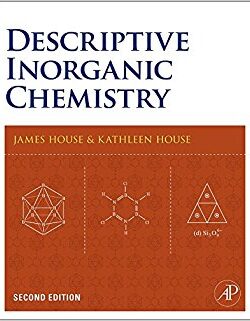
Inorganic Chemistry – James E. House – 1ra Edición
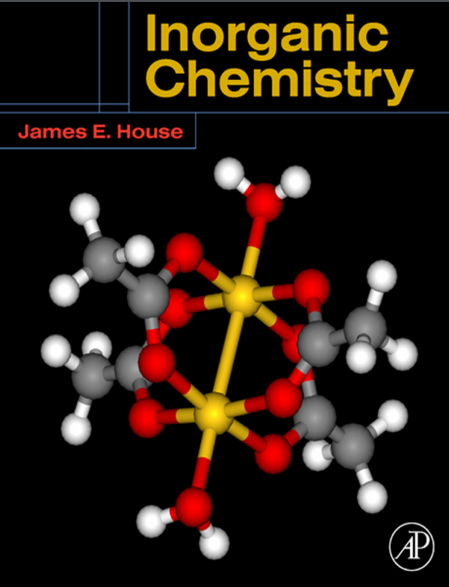
Descripción
La Química Inorgánica proporciona información esencial en las principales áreas de la química inorgánica. El autor hace hincapié en los principios fundamentales, que incluyen la estructura molecular, la química ácido-base, la química de coordinación, la teoría del campo de ligandos y la química del estado sólido, y presenta los temas de una manera clara y concisa.
La cobertura concisa maximiza la comprensión del alumno y minimiza la inclusión de detalles que es poco probable que los estudiantes utilicen. La discusión de los elementos comienza con capítulos de encuestas centrados en los grupos principales, mientras que los capítulos posteriores cubren los elementos con mayor detalle. Cada capítulo se abre con presentaciones narrativas e incluye figuras, tablas y conjuntos de problemas al final del capítulo.
Este texto es ideal para estudiantes avanzados de pregrado y posgrado matriculados en el curso de química inorgánica. El texto también puede ser adecuado para bioquímica, química médica y otros profesionales que deseen aprender más sobre este tema.
I. STRUCTURE OF ATOMS AND MOLECULES
1. Light, Waves, and Atoms
1.1 Some Early Experiments in Atomic Physics
1.2 The Nature of Light
1.3 The Bohr Model
1.4 Particle-Wave Duality
1.5 Electronic Properties of Atoms
1.6 Nuclear Binding Energy
1.7 Nuclear Stability
1.8 Types of Nuclear Decay
1.9 Predicting Decay Modes
2. Basic Quantum Mechanics and Atomic Structure
2.1 The Postulates
2.2 The Hydrogen Atom
2.3 The Helium Atom
2.4 Slater Wave Functions
2.5 Electron Configurations
2.6 Spectroscopic States
3. Covalent Bonding in Diatomic Molecules
3.1 The Basic Ideas of Molecular Orbital Methods
3.2 The H2+ and H2 Molecules
3.3 Diatomic Molecules of Second Row Elements
3.4 Photoelectron Spectroscopy
3.5 Heteronuclear Diatomic Molecules
3.6 Electronegativity
3.7 Spectroscopic States for Diatomic Molecules
4. A Survey of Inorganic Structure and Bonding
4.1 Structures of Molecules Having Single Bonds
4.2 Resonance and Formal Charge
4.3 Complex Structures;A Preview of Coming Attractions
4.4 Electron Deficient Molecules
4.5 Structures Having Unsaturated Rings
4.6 Bond Energies
5. Symmetry and Molecular Orbitals
5.1 Symmetry Elements
5.2 Orbital Symmetry
5.3 A Brief Look at Group Theory
5.4 Construction of Molecular Orbitals
5.5 Orbitals and Angles
5.5 Simple Calculations Using the Hückel Method
II. CONDENSED PHASES
6. Intermolecular Interactions
6.1 Dipole Moments
6.2 Dipole-Dipole Forces
6.3 Dipole-Induced Dipole Forces
6.4 London (Dispersion) Forces
6.5 van der Waals Equation
6.6 Hydrogen Bonding
6.7 Cohesion Energy and Solubility Parameters
7. Ionic Bonding and Structures of Solids
7.1 Energetics of Crystal Formation
7.2 Madelung Constants
7.3 The Kapustinskii Equation
7.4 Ionic Sizes and Crystal Environment
7.5 Crystal Structures
7.6 Solubility of Ionic Compounds
7.7 Proton and Electron Affinities
7.8 Structures of Metals
7.9 Defects in Crystals
7.10 Phase Transitions in Solids
7.11 Heat Capacity
7.12 Hardness of Solids
8. Dynamic Processes in Inorganic Solids
8.1 Characteristics of Solid State Reactions
8.2 Kinetic Models for Reactions in Solids
8.3 Thermal Methods of Analysis
8.4 Effects of Pressure
8.5 Reactions in Some Solid Inorganic Compounds
8.6 Phase Transitions
8.7 Reactions at Interfaces
8.8 Diffusion in Solids
8.9 Sintering
8.10 Drift and Conductivity
III. ACIDS, BASES, AND SOLVENTS
9. Acid-Base Chemistry
9.1 Arrhenius Theory
9.2 Brønsted-Lowry Theory
9.3 Factors Affecting Strength of Acids and Bases
9.4 Acid-Base Character of Oxides
9.5 Proton Affinities
9.6 Lewis Theory
9.7 Catalytic Behavior of Acids and Bases
9.8 The Hard-Soft Interaction Principle
9.9 Electronic Polarizabilities
9.10 The Drago Four-Parameter Equation
10. Chemistry in Nonaqueous Solvent
10.1 Some Common Nonaqueous Solvents
10.2 The Solvent Concept
10.3 Amphoteric Behavior
10.4 The Coordination Model
10.5 Chemistry in Liquid Ammonia
10.6 Liquid HF
10.7 Liquid Sulfur Dioxide
10.8 Superacids
IV. CHEMISTRY OF THE ELEMENTS
11. Chemistry of Metallic Elements
11.1 The Metallic Elements
11.2 Band Theory
11.3 Groups IA and IIA
11.4 Zintl Phases
11.5 Chemistry of Aluminum and Beryllium
11.6 First Row Transition Metals
11.7 Second and Third Row Transition Metals
11.8 Alloys
11.9 Chemistry of Transition Metals
11.10 Lanthanides
12. Organometallic Compounds of Main Group Metals
12.1 Preparation of Organometallic Compounds
12.2 Organometallic Compounds of Group IA Metals
12.3 Organometallic Compounds of Group IIA Metals
12.4 Organometallic Compounds of Group IIIA Metals
12.5 Organometallic Compounds of Group IVA Metals
12.6 Organometallic Compounds of Group VA Elements
12.7 Organometallic Compounds of Zn, Cd, and Hg
13. Chemistry of Nonmetallic Elements I. Hydrogen, Boron, Oxygen and Carbon
13.1 Hydrogen
13.2 Boron
13.3 Oxygen
13.4 Carbon
14. Chemistry of Nonmetallic Elements II.
14.1 Silicon, Germanium, Tin, and Lead
14.2 Nitrogen
14.3 Phosphorus, Arsenic, and Antimony
15. Chemistry of Nonmetallic Elements III. Groups VIA-VIIIA
15.1 Sulfur, Selenium, and Tellurium
15.2 Halogens
15.3 Noble Gases
V. CHEMISTRY OF COORDINATION COMPOUNDS
Introduction to Coordination Chemistry
16.1 Structures of Coordination Compounds
16.2 Metal-Ligand Bonds
16.3 Naming Coordination Compounds
16.4 Isomerism
16.5 A Simple Valence Bond Description of Coordinate Bonds
16.6 Magnetism
16.7 A Survey of Complexes of First Row Metals
16.8 Complexes of Second and Third Row Metals
16.9 The 18-Electron Rule
16.10 Back Donation
16.11 Complexes of Dinitrogen, Dioxygen, and Dihydrogen
Ligand Fields and Molecular Orbitals
17.1 Splitting of d Orbital Energies in Octahedral Fields
17.2. Splitting of d Orbital Energies in Fields of Other Symmetry
17.3 Factors Affecting
17.4 Consequences of Crystal Field Splitting
17.5 Jahn-Teller Distortion
17.6 Spectral Bands
17.7 Molecular Orbitals in Complexes
Interpretation of Spectra
18.1 State Splitting
18.2 Orgel Diagrams
18.3 Quantitative Methods
18.4 Racah Parameters
18.5 The Nephelauxetic Effect
18.6 Tanabe-Sugano Diagrams
18.7 The Lever Method
18.8 Jørgensen's Method
18.9 Charge Transfer Absorption
Composition and Stability of Complexes
19.1 Composition of Complexes in Solution
19.2 Job's Method of Continuous Variations
19.3 Equilibria Involving Complexes
19.4 Distribution Diagrams
19.5 Factors Affecting the Stability of Complexes
Synthesis and Reactions of Coordination Compounds
20.1 Synthesis of Coordination Compounds
20.2 Substitution in Octahedral Complexes
20.3 Crystal Field Effects
20.4 Acid Catalyzed Reactions of Complexes
20.5 Base Catalyzed Reactions of Complexes
20.6 The Compensation Effect
20.7 Linkage Isomerization
20.8 Substitution in Square Planar Complexes
20.9 The Trans Effect
20.10 Electron Transfer Reactions
20.11 Reactions in Solid Coordination Compounds
Complexes Containing Metal-Carbon and Metal-Metal Bonds
21.1 Binary Metal Carbonyls
21.2 Structures of Metal Carbonyls
21.3 Bonding of Carbon Monoxide to Metals
21.4 Preparation of Metal Carbonyls
21.5 Reactions of Metal Carbonyls
21.6 Structure and Bonding in Metal-Alkene Complexes
21.7 Preparation of Metal Alkene Complexes
21.8 Chemistry of Cyclopentadienyl and Related Complexes
21.9 Reactions of Ferrocene and Other Metallocenes
21.10 Complexes of Benzene and Related Aromatics
21.11 Compounds Containing Metal-Metal Bonds
21.12 Carbonyl Hydrides
Coordination Compounds in Catalysis and Biochemistry
22.1 Elementary Steps in Catalysis
22.2 Homogeneous Catalysis
22.3 Bioinorganic chemistry.
Consulta los datos bibliográficos de esta edición para identificar correctamente el recurso, revisar su autoría y verificar detalles como ISBN, tema, subtema, archivo e idioma.
- Título: Inorganic Chemistry
- Autor/es: James E. House
- Edición: 1ra Edición
- Año de publicación: 2010
- Tipo de archivo: eBook
- Idioma: eBook en Inglés
- Editorial: Elsevier Science & Technology Books
- Páginas: 864
- ISBN-13: 9780080918792
- Subtema: Química Inorgánica
Citar este libro
Preparando citaciones...



Aún no hay comentarios
Sé el primero en compartir tu opinión sobre este contenido.
Escribir un comentario