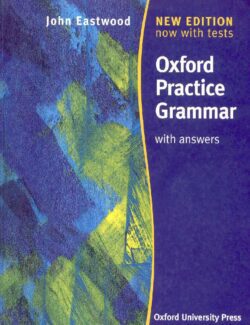
Oxford Practice Grammar Intermediate with Answers – John Eastwood
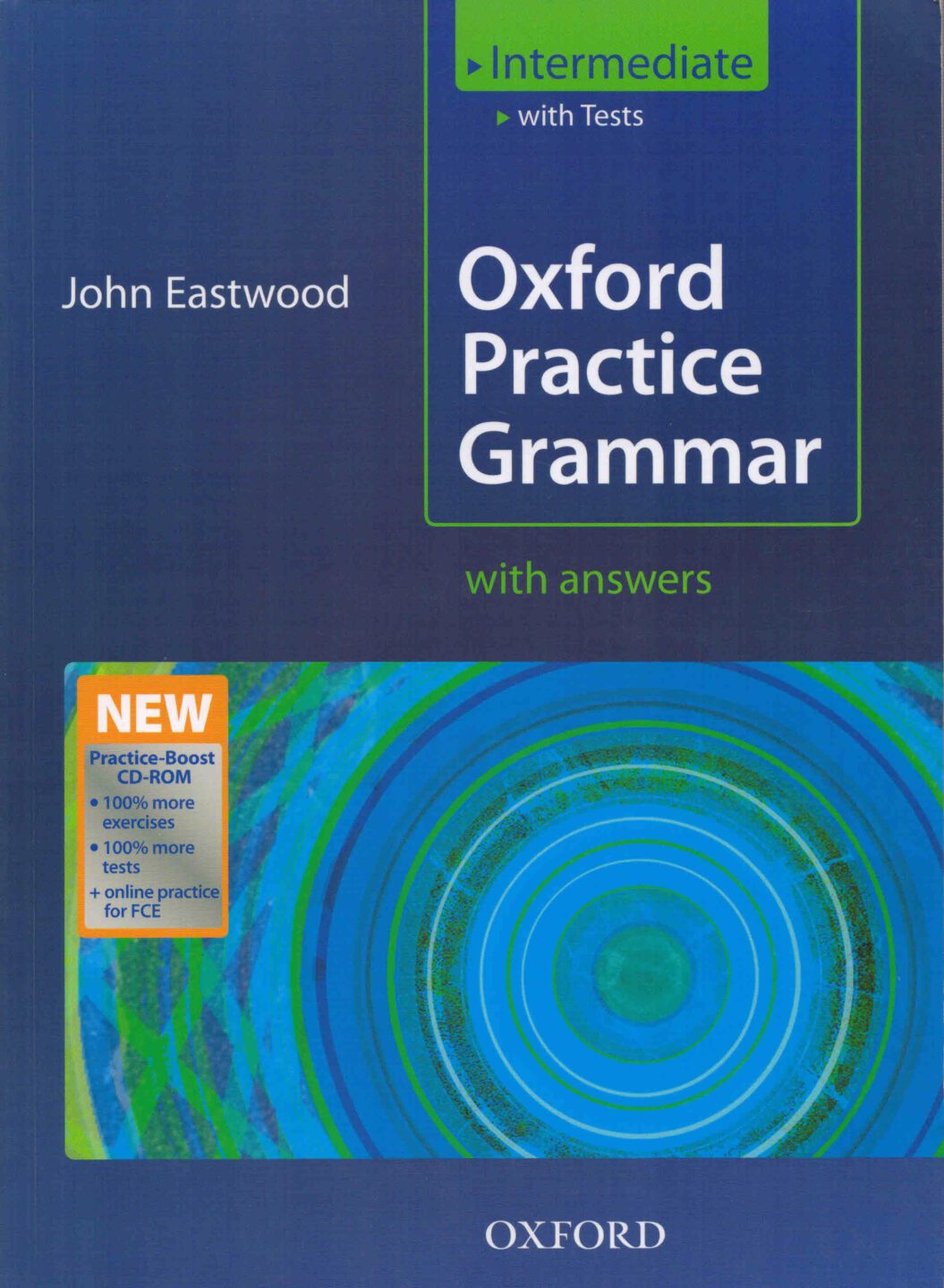
Descripción
¿A quién va dirigido este libro? Oxford Practice Grammar está dirigido a estudiantes de inglés de nivel medio o «intermedio». Es decir, a estudiantes que ya no son principiantes pero que todavía no son expertos en inglés. El libro es adecuado para quienes estudian para el Cambridge First Certificate in English. Puede ser utilizado por estudiantes que asisten a clases o por alguien que trabaja solo. ¿En qué consiste el libro? El libro consta de 153 unidades, cada una sobre un tema gramatical. Las unidades cubren las principales áreas de la gramática inglesa. Se presta especial atención a aquellos puntos que suelen ser un problema para los estudiantes: el significado de las diferentes formas verbales, el uso de la voz pasiva, los condicionales, las preposiciones, etc.
Muchas unidades contrastan dos o más estructuras diferentes, como el presente perfecto y el pasado simple $Unidades 14-15$. También hay varias unidades de repaso. El énfasis a lo largo de todo el libro está en el significado y el uso de las formas en situaciones. La mayoría de las unidades comienzan con un diálogo, o a veces un texto, que muestra cómo se utilizan las formas en un contexto realista. También hay 25 pruebas. Estos se encuentran después de cada grupo de unidades y cubren el área de gramática tratada en esas unidades. Cada unidad consta de una explicación del punto gramatical seguido de una serie de ejercicios. Casi todas las unidades ocupan dos páginas. Las explicaciones están en la página de la izquierda y los ejercicios en la de la derecha. Hay algunas unidades de cuatro páginas, con dos páginas de explicación y dos páginas de ejercicios.
Los ejemplos utilizados para ilustrar las explicaciones están en su mayoría en inglés conversacional cotidiano, excepto cuando la estructura es más típica de un estilo formal o escrito $por ejemplo, Unidad 75B$. También hay apéndices sobre varios otros temas, incluida la formación de palabras, el inglés americano y los verbos irregulares. ¿Qué hay de nuevo en esta edición? Ha habido muchos cambios tanto en el contenido como en el diseño del libro. El número de unidades se ha aumentado de 120 a 153. Hay más unidades de dos páginas y menos unidades de cuatro páginas. Los 25 exámenes son una característica nueva. También hay un examen de inicio para ayudar a los estudiantes a descubrir lo que necesitan estudiar. Hay muchos más diálogos e ilustraciones en las páginas de explicación. Muchos de los ejemplos y situaciones son nuevos. Hay muchos ejercicios nuevos y más tipos diferentes de ejercicios.
El número de apéndices se ha incrementado de dos a seis. Esta nueva edición presenta un grupo de personajes cuyas vidas son la base de muchas de las situaciones tanto en las explicaciones como en los ejercicios. $Pero aún puedes hacer las unidades en cualquier orden$. ¿Cómo se debe utilizar el libro? Hay varias formas de utilizar el libro. Si sabes que tienes problemas con puntos gramaticales particulares, puedes comenzar con las unidades relevantes. La lista de contenidos y el índice te ayudarán a encontrar lo que quieres. O puedes hacer la prueba de inicio $ver página viii$ y luego usar los resultados para decidir en qué partes del libro concentrarte. O puedes comenzar por el principio del libro y trabajar hasta el final, aunque los temas gramaticales no están ordenados según su nivel de dificultad. Cuando estudies una unidad, comienza con la página de explicación y luego continúa con los ejercicios. A menudo puedes estudiar una parte de la explicación y luego hacer uno de los ejercicios. La letra que aparece después del título de cada ejercicio, por ejemplo $A$, indica a qué parte de la explicación se refiere el ejercicio. Si ha cometido errores en sus respuestas a los ejercicios, vuelva a consultar la explicación.
Introduction page
Key to symbols
Starting test
Words and sentences
1 Word classes: nouns, verbs, adjectives, etc
2 Sentence structure: subject, verb, object, etc
3 Direct and indirect objects
Verbs
4 The present continuous
5 The present simple
6 Present continuous or simple?
7 State verbs and action verbs
Test 1: Present tenses
8 The past simple
9 The past continuous
10 Past continuous or simple?
Test 2: Past simple and past continuous
11 The present perfect (1)
12 The present perfect (2): just, already, yet, for and since
13 The present perfect (3): ever, this week, etc
14 Present perfect or past simple? (1)
15 Present perfect or past simple? (2)
Test 3: Present perfect and past simple
16 The present perfect continuous
17 Present perfect continuous or simple?
18 The past perfect
19 Review of the past simple, continuous and perfect
20 The past perfect continuous
Test 4: Past and perfect tenses
21 Review of present and past tenses
Test 5: Present and past tenses
22 Introduction to the future
23 Will and shall
24 Be going to
25 Will and be going to
26 Present tenses for the future
27 When I get there, before you leave, etc
Test 6: The future with will, be going to and present tenses
28 Will be doing
29 Will have done and was going to
30 Review of the future
Test 7: The future
31 The verb have
32 Short forms, e.g it's, don't
33 Emphatic do
Questions, negatives and answers
34 Yes/no questions
35 Short answers, e.g. Yes, it is.
36 Wh-questions
37 Subject/object questions
38 Prepositions in wh-questions
39 Who, what or which?
Test 8: Questions
40 Negative statements
41 Negative questions
42 Question tags, e.g. isn't it?
43 So/Neither do I and I think so
Test 9: Questions, negatives and answers
Modal verbs
44 Ability: can, could and be able to 108
45 Permission: can, may, could and
be allowed to 110
46 Possibility and certainty: may, might, could, must, etc
47 Necessity: must and have to
48 Necessity: mustn't, needn't, etc
49 Should, ought to, had better and be supposed to
50 Asking people to do things
51 Suggestions, offers and invitations
52 Will, would, shall and should
53 It may/could/must have been, etc
Test 10: Modal verbs
The passive
54 Passive verb forms
55 Active and passive (1)
56 Active and passive (2)
57 Special passive structures
58 Have something done 73$
59 To be done and being done
Test 11: The passive
The infinitive and the ing-form
60 Verb + to-infinitive
61 Verb + ing-form
62 Verb + to-infinitive or verb + ing-form?
63 Like, start, etc
64 Remember, regret, try, etc
Test 12: Verb + to-infinitive or ing-form
65 Verb + object + to-infinitive or ing-form
66 Question word + to-infinitive
67 Adjective + to-infinitive
68 For with the to-infinitive
69 The infinitive with and without to
70 Verb/Adjective + preposition + ing-form
71 Afraid to do or afraid of doing?
72 Used to do and be used to doing
73 Preposition or linking word + ing-form
74 See it happen or see it happening?
75 Some structures with the ing-form
Test 13: The infinitive and the ing-form
Nouns and articles (a/an and the)
76 Ship and water: countable and uncountable nouns
77 A carton of milk, a piece of information, etc
78 Nouns that can be either countable or uncountable
79 Agreement
80 Singular or plural?
81 Pair nouns and group nouns
82 Two nouns together
Test 14: Nouns and agreement
83 A/an and the (1)
84 A/an and the (2)
85 A/an, one and some
86 Cars or the cars?
87 Prison, school, bed, etc
88 On Friday, for lunch, etc
89 Quite a, such a, what a, etc
90 Place names and the
Test 15: A/an and the
This, my, some, a lot of, all, etc
91 This, that, these and those
92 My, your, etc and mine, yours, etc
93 The possessive form and of
94 Some and any
95 A lot of, many, much, (a) few and (a) little
96 All, half, most, some, no and none
97 Every, each, whole, both, either and neither
Test 16: This, my, some, a lot of, all, etc
Pronouns
98 Personal pronouns, e.g. I, you
99 There and it
100 Reflexive pronouns
101 Emphatic pronouns and each other
102 The pronoun one/ones
103 Everyone, something, etc
Test 17: Pronouns
Adjectives and adverbs
104 Adjectives
105 The order of adjectives
106 The old, the rich, etc
107 Interesting and interested
108 Adjective or adverb? (1)
109 Adjective or adverb? (2)
Test 18: Adjectives and adverbs
110 Comparative and superlative forms
111 Comparative and superlative patterns (1)
112 Comparative and superlative patterns (2)
Test 19: Comparative and superlative
113 Adverbs and word order
114 Yet, still and already
115 Adverbs of degree, e.g. very, quite
116 Quite and rather
117 Too and enough
Test 20: Adverbs and word order
Consulta los datos bibliográficos de esta edición para identificar correctamente el recurso, revisar su autoría y verificar detalles como ISBN, tema, subtema, archivo e idioma.
- Título: Oxford Practice Grammar Intermediate with Answers
- Autor/es: John Eastwood
- Edición: 1ra Edición
- Año de publicación: 2019
- Tipo de archivo: eBook
- Idioma: eBook en Inglés
- Editorial: Oxford University Press
- Páginas: 384
- ISBN-10: 0194214745
- ISBN-13: 9780194214742
- Subtema: Inglés
Citar este libro
Preparando citaciones...

![English Grammar in Use [Cambridge] - Raymond Murphy - 2nd Edition](https://elsolucionario.net/wp-content/archivos/2018/02/english-grammar-in-use-cambridge-raymond-murphy-2nd-edition-250x325.jpg "English Grammar in Use [Cambridge] – Raymond Murphy – 2nd Edition")
Aún no hay comentarios
Sé el primero en compartir tu opinión sobre este contenido.
Escribir un comentario