Physical Chemistry Thermodynamics, Structure, and Change – Peter Atkins, Julio de Paula – 10th Edition
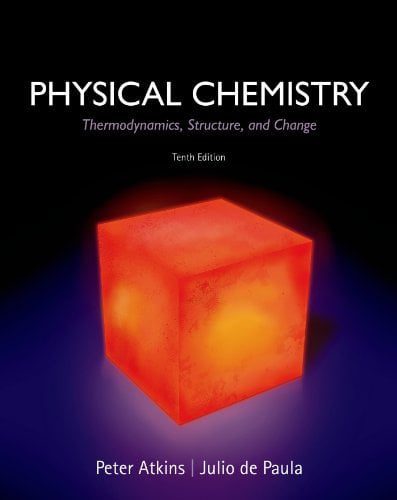
Descripción
Los libros de vista molecular de la química física, las aplicaciones contemporáneas, la pedagogía amigable para los estudiantes y el fuerte énfasis en la resolución de problemas lo hacen especialmente adecuado para estudiantes de medicina, ingeniería, física y química.
Ahora organizada en temas más breves y manejables, y con aplicaciones adicionales y orientación matemática, la nueva edición ayuda a los estudiantes a aprender de manera más efectiva, al tiempo que permite a los instructores enseñar de la manera que desean.
Table of Contents:
It occupies fourteen pages. Here is a succinct overview:
Chemistry is the science of matter and the changes it can
undergo. Physical chemistry is the branch of chemistry that
establishes and develops the principles of the subject in terms
of the underlying concepts of physics and the language of
mathematics. It provides the basis for developing new spectroscopic
techniques and their interpretation, for understanding
the structures of molecules and the details of their electron
distributions, and for relating the bulk properties of matter
to their constituent atoms. Physical chemistry also provides a
window on to the world of chemical reactions, and allows us to
understand in detail how they take place.
A Matter
Throughout the text we draw on a number of concepts that
should already be familiar from introductory chemistry, such
as the 'nuclear model' of the atom, 'Lewis structures' of molecules,
and the 'perfect gas equation'. This Topic reviews these
and other concepts of chemistry that appear at many stages of
the presentation.
B Energy
Because physical chemistry lies at the interface between
physics and chemistry, we also need to review some of the
concepts from elementary physics that we need to draw on in
the text. This Topic begins with a brief summary of 'classical
mechanics', our starting point for discussion of the motion
and energy of particles. Then it reviews concepts of 'thermodynamics'
that should already be part of your chemical
vocabulary. Finally, we introduce the 'Boltzmann distribution'
and the 'equipartition theorem', which help to establish
connections between the bulk and molecular properties of
matter.
C Waves
This Topic describes waves, with a focus on 'harmonic waves',
which form the basis for the classical description of electromagnetic
radiation. The classical ideas of motion, energy, and
waves in this Topic and Topic B are expanded with the principles
of quantum mechanics (Chapter 7), setting the stage for
the treatment of electrons, atoms, and molecules. Quantum
mechanics underlies the discussion of chemical structure
and chemical change, and is the basis of many techniques of
investigation
Consulta los datos bibliográficos de esta edición para identificar correctamente el recurso, revisar su autoría y verificar detalles como ISBN, tema, subtema, archivo e idioma.
- Título: Physical Chemistry Thermodynamics Structure and Change
- Autor/es: Peter Atkins | Julio de Paula
- Edición: 10ma Edición
- Año de publicación: 2014
- Tipo de archivo: eBook
- Idioma: eBook en Inglés
- Editorial: W. H. Freeman
- Páginas: 1040
- ISBN-10: 1429290196
- ISBN-13: 9781429290197
- Subtema: Química Física
Citar este libro
Preparando citaciones...






Aún no hay comentarios
Sé el primero en compartir tu opinión sobre este contenido.
Escribir un comentario