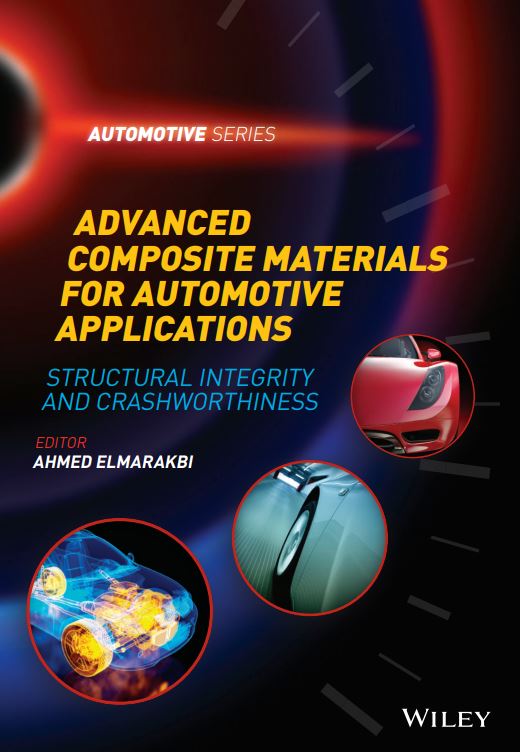
Advanced Composite Materials for Automotive Applications – Ahmed Elmarakbi – 1st Edition
Descripción
En una industria automotriz donde la reducción de peso, la eficiencia energética y la seguridad al impacto juegan roles cada vez más determinantes, los materiales compuestos avanzados emergen como una de las soluciones tecnológicas más prometedoras. Este libro reúne contribuciones de expertos mundiales y explora cómo las aleaciones ligeras, las matrices plásticas reforzadas, los materiales híbridos y las tecnologías de unión están redefiniendo el diseño y la fabricación del vehículo moderno. El volumen se estructura en bloques temáticos que van desde los fundamentos de los compuestos (qué son, cómo se comportan, cómo se modelan sus propiedades mecánicas) hasta el diseño estructural orientado a la absorción de energía en choques (crashworthiness), pasando por modelos de daño, simulaciones por elementos finitos, estudios de casos industriales y aplicaciones concretas por ejemplo ruedas compuestas con motor de cubo integrado, sistemas de freno ligeros, paneles de carrocería híbridos metal-compuesto, etc.
Las contribuciones no solo describen los materiales sino que abordan el proceso completo: selección, conformado en masa, análisis de fallo, reciclaje, coste. Para un estudiante universitario de ingeniería (especialmente automotriz, mecánica, de materiales o producción) que busca ir más allá de los textos básicos sobre motor o chasis, este libro ofrece un salto cualitativo: permite comprender no solo «qué material se usa», sino «por qué se usa», «cómo se diseña para un vehículo», «cómo su comportamiento dinámico y frente a impactos afecta al diseño del vehículo», y «qué implicaciones tiene para producción en masa, coste, seguridad y reciclabilidad». La obra resulta igualmente útil para jóvenes profesionales que se incorporan al sector automotriz o al desarrollo de materiales compuestos. Entre sus ventajas destacan: la integración entre teoría de compuestos, modelado avanzado, análisis de fallo estructural y aplicaciones automotrices; la presentación de casos reales (lo que facilita al lector ver el puente teoría-industria); y la extensión hacia retos contemporáneos como materiales «verdes», economía circular y fabricación de alta velocidad para automoción. En definitiva, el libro representa una referencia avanzada sobre el uso de materiales compuestos en automoción, particularmente centrada en la integridad estructural y la seguridad de impacto temas cada vez más relevantes en un contexto de movilidad sostenible y normativas exigentes.
About the Editor
List of Contributors
Series Preface
Preface
Part One FUNDAMENTAL BACKGROUND
1 Overview of Composite Materials and their Automotive Applications
1.1 Introduction
1.2 Polymer Composite Materials
1.2.1 Non-Structural Composites
1.2.2 Semi-Structural Composites
1.2.3 Structural Composites
1.2.4 Laminated Composites
1.2.5 Textile Composites
1.2.6 Hybrid Composites
1.3 Application of Composite Materials in the Automotive Industry
1.3.1 Crashworthiness
1.3.2 Composite Driveshaft and Spring
1.3.3 Other Applications
1.4 Green Composites for Automotive Applications
1.5 Modelling the Mechanical Behaviour of Composite Materials
1.5.1 Modelling the Elastic Properties of Unidirectional Composites
1.5.2 Modelling of Laminated and Textile Composites
1.5.2.1 Analytical Modelling
1.5.2.2 Numerical FE Modelling
1.6 Discussion
1.7 Conclusion
References
2 High-Volume Thermoplastic Composite Technology for Automotive Structures
2.1 Introduction - Opportunities for Thermoplastic Composites
2.2 Recent Developments in Automotive TPCs
2.3 Case Study: Rapid Stamp-Formed Thermoplastic Composites
2.3.1 Materials Selection: Exploring the Potential of Aligned Fibre TPCs
2.3.2 Demonstrator Beam Component
2.3.3 TPC Process Development
2.3.4 Beam Manufacture
2.3.5 Demonstrator Beam Structural Performance
2.3.6 Environmental Impact Assessment
2.3.7 Economic Analysis
2.4 Conclusion
Acknowledgements
References
3 Development of Low-Cost Carbon Fibre for Automotive Applications
3.1 Introduction
3.2 Research Drivers: Energy Efficiency
3.3 Lightweight Automotive Materials
3.4 Barriers to Carbon Fibre Adoption in the Automotive Industry
3.5 Global Production and the Market for Carbon Fibre
3.6 Low-Cost Carbon Fibre Programme
3.6.1 Project Aims
3.6.2 Precursor Materials
3.6.2.1 Commodity PAN-Based Precursors
3.6.2.2 Lignin-Based Precursors
3.6.2.3 Polyolefin-Based Precursors
3.6.3 Advanced Processing Techniques
3.6.3.1 Microwave Assisted Plasma Processing
3.6.3.2 Advanced Stabilisation/Crosslinking
3.6.3.3 Plasma Oxidation
3.6.3.4 Advanced Surface Treatment and Sizing
3.6.4 Integration: Low-Cost Carbon Fibre Pilot Line
3.7 International Cooperation
Acknowledgements
References
Part Two IMPACT AND CRASH ANALYSIS
4 Mechanical Properties of Advanced Pore Morphology Foam Composites
4.1 Introduction
4.2 Cellular Materials
4.2.1 Mechanical Behaviour of Cellular Materials
4.2.2 Energy Absorption Capabilities of Cellular Materials
4.2.3 Influence of Pore Fillers
4.2.4 Strain Rate Sensitivity of Cellular Materials
4.3 Advanced Pore Morphology Foam
4.4 Mechanical Properties of Single APM Foam Elements
4.5 Behaviour of Composite APM Foam
4.5.1 Compressive Loading of Confined APM Foam Elements without Bonding
4.5.2 Partially Bonded APM Foam Elements
4.5.3 Fully Bonded APM Foam Elements - Syntactic Structure
4.6 Conclusion
Acknowledgements
References
5 Automotive Composite Structures for Crashworthiness
5.1 Introduction
5.2 Traffic Safety
5.3 Alternative Vehicles
5.4 Selective Overview of Worldwide Crash Tests
5.5 Structural Crash Management
5.5.1 Front Crash
5.5.2 Side Crash
5.6 Composite Materials for Crash Applications
5.6.1 Performance Metrics for Energy Absorbing Structures
5.6.2 Energy Absorbing Deformation Mechanisms in Composite Profiles
5.7 Energy Absorption of Composite Profiles
5.7.1 Fibre Material
5.7.2 Matrix Material
5.7.3 Fibre Volume Fraction
5.7.4 Fibre Architecture
5.7.5 Trigger
5.7.6 Geometry
5.7.7 Test Speed
5.7.8 Test Direction
5.8 Conclusion
Acknowledgements
References
6 Crashworthiness Analysis of Composite and Thermoplastic Foam Structure for Automotive Bumper Subsy
6.1 Introduction
6.2 Materials for Automotive Applications
6.3 Composite and Thermoplastic Materials
6.4 Numerical Modelling of Fiat 500 Frontal Transverse Beam
6.5 Standards for Low-Speed Frontal Impact
6.6 Bumper Beam Thickness Determination
6.7 Results and Discussion
6.8 Conclusion
References
7 Hybrid Structures Consisting of Sheet Metal and Fibre Reinforced Plastics for Structural Automotiv
7.1 Introduction and Motivation
7.2 Conventional Method for the Development of Composite Structures
7.3 Approaches to Automotive Lightweight Construction
7.4 Requirements for Automotive Structures
7.4.1 Mechanical Requirements
7.4.2 Load Adapted Design
7.4.3 Derivation of Reference Structures
7.5 Simulation
7.6 Manufacturing
7.6.1 Overview
7.6.2 Prepreg Press Technology: Basic Investigations and Process Parameters
7.6.3 Prepreg Press Technology: Bonding of Composite Material and Sheet Metal
7.7 Testing
7.7.1 Quasi-Static Tests
7.7.2 Crash Tests
7.8 New Methodology for the Product Engineering of Hybrid Lightweight Structures
7.9 Conclusion
References
8 Nonlinear Strain Rate Dependent Micro-Mechanical Composite Material Model for Crashworthiness Simu
8.1 Introduction
8.2 Micro-Mechanical Formulation
8.2.1 Equations for Micro-Mechanical Model
8.2.1.1 Constitutive Equations for Composite Materials
8.2.1.2 Micro-Mechanics Constitutive Model
8.2.1.3 Constitutive Matrices and Stress Update for the Micro-Model
8.2.2 Failure Analysis
8.2.3 Finite Element Implementation
8.2.3.1 Equations in Incremental Form
8.2.3.2 Localisation and Modification
8.2.4 Verification Examples
8.3 Strain Rate Dependent Effects
8.3.1 Strain Rate Effect Introduction and Review
8.3.1.1 Strain Rate Effect on Polymer Resin
8.3.1.2 State Variable Modelling Overview
8.3.2 One-Dimensional Equation and Material Constant Determination
8.3.2.1 One-Dimensional Constitutive Equation
8.3.2.2 Material Constant Determination
8.3.3 Three-Dimensional Constitutive Equations
8.3.3.1 Original Flow Equation
8.3.3.2 Modified Equations with Shear Correction Factor
8.3.3.3 Three-Dimensional Extension of Internal Stress Evolution Law
8.3.4 Finite Element Implementation
8.3.4.1 Shell Element Simulation
8.3.4.2 Solid Element Simulation
8.4 Numerical Results
8.5 Conclusion
References
9 Design Solutions to Improve CFRP Crash-Box Impact Efficiency for Racing Applications
9.1 Introduction
9.2 Composite Structures for Crashworthy Applications
9.3 Geometrical and Material Characterisation of the Impact Attenuator
9.4 Experimental Test
9.5 Finite Element Analysis and LS-DYNA
9.6 Comparison between Numerical and Experimental Analysis
9.7 Investigation of the Optimal Solution
9.8 Conclusion
References
Part Three DAMAGE AND FAILURE
10 Fracture and Failure Mechanisms for Different Loading Modes in Unidirectional Carbon Fibre/Epoxy
10.1 Introduction
10.2 Delamination Failure
10.3 Objectives
10.4 Experimental Programme
10.4.1 Materials and Laminate Manufacturing
10.4.2 Testing Methods
10.4.2.1 Mode I Test Method
10.4.2.2 Mixed Mode I/II: ADCB Test
10.4.2.3 Mixed Mode I/II: MMB Test
10.4.2.4 Mode II Test Method
10.5 Numerical Simulations
10.5.1 Virtual Crack Closure Technique
10.5.2 Two-Step Extension Method
10.5.3 Cohesive Zone Model
10.6 Fractography
10.7 Results and Discussion
10.7.1 Experimental Results
10.7.2 Numerical Results
10.7.3 Fractographic Analysis
10.7.4 Stress State at the Crack Front
10.8 Conclusion
References
11 Numerical Simulation of Damages in FRP Laminated Structures under Transverse Quasi-Static or Low-
11.1 Introduction
11.2 Theory
11.2.1 Theory of Finite Element Method
11.2.2 Damage Models
11.2.2.1 In-Plane Damage
11.2.2.2 Theory of Traditional Cohesive Element for Modelling Delamination
11.3 Techniques for Overcoming Numerical Instability in Simulation of Delamination Propagation
11.3.1 Artificial Damping Technique
11.3.2 Move-Limit Technique Enforced on Cohesive Zone
11.3.3 Adaptive Cohesive Model
11.3.3.1 Rate-Independent Adaptive Cohesive Model
11.3.3.2 Rate-Dependent Adaptive Cohesive Model
11.4 Numerical Examples
11.4.1 DCB Problem
11.4.1.1 Standard Numerical Simulations
11.4.1.2 Artificial Damping Technique
11.4.1.3 Move-Limit Technique
11.4.1.4 Rate-Independent ACM
11.4.1.5 Rate-Dependent ACM
11.4.2 Low-Velocity Impact Problem
11.5 Conclusion
References
12 Building Delamination Fracture Envelope under Mode I/Mode II Loading for FRP Composite Materials
12.1 Introduction
12.2 Experimental Studies
12.3 Mode I Delamination Testing: Double Cantilever Bending Test Analysis and Results
12.4 Mode II Delamination Testing: End Notched Flexure Test Analysis and Results
12.5 Mixed Mode I/II Delamination Testing: Mixed-Mode Bending Test Analysis and Results
12.6 Fracture Failure Envelope
12.7 Conclusion
Nomenclature
References
Part Four CASE STUDIES AND DESIGNS
13 Metal Matrix Composites for Automotive Applications
13.1 Automotive Technologies
13.1.1 Current Landscape
13.1.2 Alternative Technologies
13.1.2.1 Hybrid Vehicles
13.1.2.2 Electric Vehicle
13.1.2.3 Fuel Cell or Hydrogen Vehicles
13.1.3 Promise for Lightweight Materials
13.1.4 Metal Matrix Composites
13.1.5 Cost-Benefit Analysis
13.2 Reinforcements
13.2.1 Solid Ceramic Reinforcements
13.2.2 Hollow Reinforcements
13.2.3 Carbon Based Materials
13.3 Automotive Applications
13.3.1 Powertrain
13.3.2 Cylinder Liner
13.3.3 Piston
13.3.4 Connecting Rod
13.3.5 Main and Other Bearings
13.3.6 Crankshaft
13.3.7 Valvetrain
13.3.8 Engine Accessories
13.3.9 Drivetrain and Suspension
13.3.10 Transmission Housing
13.3.11 Differential Housing
13.3.12 Driveshaft
13.3.13 Brake
13.3.14 Mount
13.3.15 Impact Zone
13.3.16 Electronics
13.3.17 Battery
13.4 Conclusion
Acknowledgements
References
14 Development of a Composite Wheel with Integrated Hub Motor and Requirements on Safety Components
14.1 Introduction
14.1.1 Lightweight as a Key Technology for Automotive Engineering
14.2 Wheels Made from FRPs
14.2.1 Structural Durability of Lightweight Wheels Made from FRP
14.2.1.1 Requirements on Composite Wheels with Respect to Fatigue
14.2.2 Operational Strength Verification of Wheels
14.2.3 Evidence of Operational Stability of Car Wheels Made from Plastic
14.2.4 Results of Fatigue Tests on Composite Wheels
14.2.4.1 Fatigue tests on CFRP wheels
14.3 Development of a Composite Wheel with Integrated Electric Motor
14.3.1 CFRP Lightweight Wheel with Integrated Electrical Motor - Characteristic Data
14.3.2 Development Process
14.3.2.1 Technical Challenges for Multifunctional Design
14.3.2.2 Design of the Wheel
14.3.2.3 Manufacturing
14.4 Multifunctional Design - Requirements regarding Structural Durability and System Reliability
14.4.1 Reliability Analysis of Multifunctional Systems
14.4.2 Qualitative Reliability Analysis of Multifunctional Systems Performed on CFRP Wheel with Inte
14.4.2.1 Quantitative System Reliability Analysis of Multifunctional Systems Performed on CFRP Wheel
14.5 Conclusion
References
15 Composite Materials in Automotive Body Panels, Concerning Noise and Vibration
15.1 Introduction
15.2 Composite Materials in Automobile Bodies
15.3 Multilayer Composite Materials in Noise and Vibration Treatment
15.4 Case Studies
15.4.1 Case Study I: Modal Analysis of Vehicle Hood
15.4.2 Case Study II: Modal Analysis of Two- or Three-Layer Damping Treatment
15.4.2.1 Unconstrained Layer Damping Treatment
15.4.2.2 Constrained Layer Damping Treatment
15.5 Conclusion
References
16 Composite Materials for Automotive Braking Systems
16.1 Introduction
16.2 Materials Requirements for Brake Rotors
16.3 Cast Iron Rotors
16.4 Carbon Composite Rotors
16.4.1 Carbon-Carbon Composites
16.4.2 Ceramic Matrix Carbon Composites
16.5 Light Alloy Composite Rotors
16.6 Evaluation of Composite Disc Materials
16.7 Surface Engineering of Light Alloy Brake Discs
16.8 Friction Material
16.8.1 Material Requirements
16.8.2 Overview of Friction Material Formulations
16.8.3 Evaluation of Friction Material Performance
16.9 Conclusion
References
17 Low-Cost Carbon Fibre: Applications, Performance and Cost Models
17.1 Current and Proposed Carbon Fibre Applications
17.2 Carbon Fibre Polymer Composites: Cost Benefits and Obstacles for Automobiles
17.3 Performance Modelling
17.3.1 Weight Saving Models
17.3.2 Models for Density. Stiffness and Strength
17.3.3 Carbon Fibre Sheet Moulding Compounds
17.3.4 Performance Modelling Summary
17.4 Cost Modelling
17.4.1 Cost of Making Carbon Fibre
17.4.2 Cost Model Results for Advanced Technologies
17.4.2.1 Carbon Fibre Cost Reduction Strategies
17.4.2.2 Non-Traditional, Lower Cost Precursor
17.4.2.3 Non-Traditional, Lower Cost Conversion Technologies
17.4.2.4 Commercialisation of Advanced Technologies
17.5 Conclusion
Acknowledgements
References
Index
Consulta los datos bibliográficos de esta edición para identificar correctamente el recurso, revisar su autoría y verificar detalles como ISBN, tema, subtema, archivo e idioma.
Haz clic en la pestaña de detalles para cargar la información de la edición.
Citar este libro
Preparando citaciones...







Aún no hay comentarios
Sé el primero en compartir tu opinión sobre este contenido.
Escribir un comentario