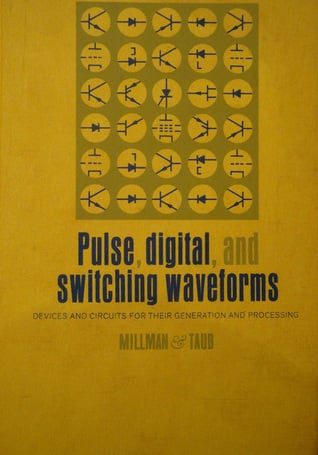
Pulse Digital Switching Wave – Jacob Millman, Herbert Taub – 1st Edition
Descripción
Los orígenes de este libro de texto clásico de pulso, digital y formas de onda de conmutación se remontan a una época anterior a la década de 1940, siendo uno de los primeros manuales en ofrecer amplios conceptos de diseño y análisis de generación de impulsos y circuitos de onda de forma sencilla y legible; y de manera amistosa.
Si bien conserva el sabor original del libro, esta edición revisada también incluye debates sobre Logic Gate Families, IC 555 Timer y Op-Amp basados en Multivibratorios para cobertura actualizada. Una gran cantidad de ejemplos resueltos, preguntas de repaso, problemas numéricos y preguntas del examen de libreta se entremezclan a lo largo del texto para proporcionar una comprensión clara de los conceptos.
CONTENTS
1. REVIEW OF AMPLIFIER CIRCUITS
1-1. Equivalent Circuit of a Vacuum Tube
1-2. Voltage Feedback in Amplifiers . 4
1-3. Current Feedback in Amplifiers . 5
1-4. Illustrations of Current and Voltage Feedback. 6
1-5. Some Characteristics of Feedback Amplifiers 8
1-6. The Cathode Follower. 11
1-7. Graphical Analysis of the Cathode Follower 13
1-8. Practical Cathode-follower Circuits. 15
1-9. Characteristics and Applications of the Cathode Follower 17
1-10. Cathode-follower-type Circuits . 17
1-11. The Operational Amplifier 22
1-12. The Principle of the Virtual Ground in Operational Amplifiers 24
1-13. Basic Uses of Operational Amplifiers 25
2. LINEAR WAVE SHAPING: RC, RL, AND RLC CIRCUITS. 28
2-1. The High-pass RC Circuit 28
2-2. The High-pass RC Circuit as a Differentiator 36
2-3. Double Differentiation. 39
2-4. The Low-pass RC Circuit. 40
2-5. The Low-pass RC Circuit as an Integrator. 46
2-6. RL Circuits. 47
2-7. RLC Circuits 48
2-8. Ringing Circuit. 52
3. LINEAR PULSE AMPLIFIERS 58
3-1. The RC Coupled Amplifier Stage 58
3-2. Steady-state Analysis of an Amplifier 59
3-3. Amplitude and Time-delay Response of an RC Coupled Amplifier
3-4. Unit Step Response of an Amplifier. 63
3-5. Transient Response of an RC Coupled Amplifier Stage 65
3-6. Shunt Compensation to Improve Rise-time Response. 67
3-7. Additional Methods of Rise-time Compensation . 72
3-8. Rise-time Response of Cascaded RC Coupled Amplifiers. 74
3-9. Rise-time Response of Cascaded Amplifiers with Overshoot. 76
3-10. Attenuators. 77
3-11. Rise-time Compensation in the Cathode Circuit 81
3-12. The Oathode Follower at High Frequencies 85
3-13. Low-frequency Compensation 89
3-14. Effect of a Cathode Bypass Capacitor on Low-frequency Response. 93
3-15. Effect of Screen Bypass on Low-frequency Response . 95
3-16. Flat-top Response of Cascaded Stages 96
3-17. The Totem-pole Amplifier. 99
3-18. Cathode Interface Resistance. 101
4. NONLINEAR WAVE SHAPING 104
4-1. Diode Characteristics. 104
4-2. Triode Characteristics. 106
4-3. Clipping or Limiting Circuits. 111
4-4. Compensation for Cathode-temperature Changes in Selectors 117
4-5. Clamping Circuits. 119
4-6. Synchronized Clamping . 126
4-7. Tubes Used as Switches . 129
4-8. An Overdriven Two-stage RC-coupled Amplifier 135
4-9. Cathode Follower with Capacitive Load 138
5. THE BISTABLE MULTIVIBRATOR. 140
5-1. The Stable States of a Binary 140
5-2. The Self-biased Binary 144
5-3. Commutating Capacitors. 146
5-4. Regeneration in a Binary. 147
5-5. Resolving Time in a Binary 150
5-6. Methods of Improving Resolution 152
5-7. Triggering of the Binary . 156
5-8. Unsymmetrical Triggering through a Triggering Tube 159
5-9. Symmetrical Triggering . 161
5-10. The Cathode-coupled Binary. 164
5-11. Hysteresis in the Cathode-coupled Binary . 168
5-12. Cathode Interface Resistance in the Binary 172
6. MONOSTABLE AND ASTABLE MULTIVIBRATORS 174
6-1. The Plate-coupled Monostable Multi-The Stable State. 174
6-2. The Quasi-stable State 175
6-3. Waveforms of Plate-coupled Multi . 178
6-4. The Influence of Tube Current II on Waveforms. 183
6-5. Recovery Time in a Monostable Multi . 184
6-6. The Cathode-coupled Monostable Multi Waveforms. 187
6-7. Overshoots in Cathode-coupled Multi . 190
6-8. Linearity of Delay of Cathode-coupled Multi 193
6-9. The Influence of E on Waveforms . 195
6-10. Triggering of the Monostable Multi. 195
6-11. The Monostable Circuit Adjusted for Free-running Operation 197
6-12. The Astable Plate-coupled Multi. 199
7. VOLTAGE TIME-BASE GENERATORS. 202
7-1. General Features of a Time-base Signal. 202
7-2. The Thyratron Sweep Circuits . 204
7-3. Vacuum-tube Sweep Circuit . 208
7-4. Circuits to Improve Sweep Linearity 213
7-5. The Miller Sweep . 217
7-6. Pentode Miller Sweep with Suppressor Gating.
7-7. Phantastron Circuits .
7-8. The Bootstrap Sweep.
7-9. Additional Methods of Linearity Improvement
8. CURRENT TIME-BASE GENERATORS
8-1. The Generator Waveform. 236
8-2. Effect of the Omission of the Impulsive Component of Current. 238
8-3. Current Drivers 240
8-4. Methods of Linearity Improvement. 244
8-5. Illustrative Current-sweep Circuits . 247
8-6. Television Sweep Circuit. 248
9. PULSE TRANSFORMERS AND BLOCKING OSCILLATORS 253
9-1. Equivalent Circuit. 253
9-2. Transformer Inductance Parameters. 256
9-3. Transformer Capacitances 259
9-4. Ferrite Cup-core Transformers . 261
9-5. Rise-time Response of a Transformer 263
9-6. The Flat Top of the Pulse 265
9-7. Decay-time Response of a Transformer. 267
9-8. Pulse-transformer Design Considerations 271
9-9. The Blocking Oscillator . 272
9-10. The Blocking-oscillator Rise Time . 275
9-11. The Blocking-oscillator Pulse Amplitude 276
9-12. The Blocking-oscillator Pulse Width. 278
9-13. The Blocking-oscillator Backswing . 280
9-14. The Blocking-oscillator Period 281
9-15. The Blocking-oscillator Output Impedance. 282
9-16. The Blocking-oscillator Output Terminals 282
9-17. The Monostable Blocking Oscillator. 283
9-18. Applications of Blocking Oscillators. 284
10. ELECTROMAGNETIC DELAY LINES 286
10-1. Distributed-parameter Lines. 286
10-2. Lumped-parameter Delay Lines. 291
10-3. Reflections on Transmission Lines 299
10-4. Delay-line Control of a Blocking Oscillator. 305
10-5. Pulse Coders 307
10-6. Pulse Decoders. 309
10-7. Distributed Amplifiers. 315
10-8. Distributed Amplifiers in Cascade 318
10-9. Practical Considerations in Distributed Amplifiers 319
11. COUNTING 323
11-1. The Binary Chain as a Divider 323
11-2. The Binary Chain as a Counter. 325
11-3. Counting to a Base Other than 2 327
11-4. Improvement of Resolution in a Binary Chain with Feedback 329
11-5. Additional Types of Decade Counters 330
11-6. Reversible Binary Counter 335
11-7. A Special Gas-filled Counter Tube . 335
11-8. A Vacuum-type Counter Tube 339
11-9. Ring Counters . 343
11-10. Application of Counters . 344
11-11. Storage Counters . 346
11-12. Linearization of Storage Counters 350
11-13. Applications of Storage Counters 352
12. SYNCHRONIZATION AND FREQUENCY DIVISION 355
12-1. Pulse Synchronization of Relaxation Devices 355
12-2. Frequency Division in the Thyratron Sweep 358
12-3. Other Astable Relaxation Circuits . 360
12-4. Monostable Relaxation Circuits as Dividers 363
12-5. Stability of Relaxation Dividers. 364
12-6. Stabilization of Frequency Dividers by Resonant Circuits 368
12-7. Synchronization of a Thyratron Sweep with Sinusoidal Signals. 372
12-8. Sine-wave Frequency Division with a Thyratron Sweep . 377
12-9. Sine-wave Synchronization of Other Relaxation Devices. 378
12-10. A Sinusoidal Divider Using Regeneration and Modulation 382
12-11. The Locked Oscillator as a Divider . 384
12-12. Synchronization of a Sinusoidal Oscillator with Pulses 386
13. DIGITAL COMPUTER CIRCUITS 392
13-1. Some Features of a Digital Computer 392
13-2. The OR Circuit. 394
13-3. The AND Circuit. 397
13-4. The NOT Circuit . 400
13-5. The INHIBITOR Circuit. 401
13-6. An Example of a Switching Circuit . 404
13-7. The AND Circuit Used for Pulse Reshaping 407
13-8. Regenerative Broadening. 409
13-9. The EXCLUSIVELY-OR Circuit 411
13-10. Registers 411
13-11. Dynamic Registers. 413
13-12. The Dynamic Binary 415
13-13. The Havens Delay Circuit 416
13-14. Binary Addition 419
13-15. Code-operated Multiposition Switch. 422
13-16. Magnetic-core Binary Elements. 425
13-17. Applications of Magnetic Binary Cores. 425
14. TRANSMISSION GATES 429
14-1. Basic Operating Principle of Gates
14-2. Unidirectional Diode Gate
14-3. An Application of the Unidirectional Diode Gate.
14-4. Other Forms of the Unidirectional Diode Gate.
14-5. Bidirectional Gates Using Multielement Tubes
14-6. Reduction of Pedestal in a Gate Circuit
14-7. A Bidirectional Diode Gate .
14-8. Balance Conditions in a Bidirectional Diode Gate.
14-9. Signal Input Impedance and Connections
14-10. Effect of Circuit Capacitances. Example
14-11. Four-diode Gate
14-12. Six-diode Gate.
14-13. Synchronous Clamp
14-14. Operation of Synchronous Clamp.
14-15. Balance Conditions in Synchronous Clamp.
a-16. Other Forms of Gating and Clamping Circuits.
15. VOLTAGE COMPARATORS
15-1. Applications of Voltage Comparator:=
15-2. ClaslSification of Comparator Circuits
15-3. A Diode in Cascade with a Nonregellerative Amplifier
15-4. Factors Affecting Comparator Operation
15-5. A Tube Operating at Cutoff
15-6. Regenerative Comparators
15-7. The Multiar.
15-8. Blocking-oscillator Comparator
15-9. The A-C Coupled Multivibrator Comparator
15-10. The D-C Cathode-coupled Multivibrator Comparator
15-11. A Gas-tube Comparator Used as a Switch
15-12. Comparators for Sinusoidal Voltages
15-13. Amplifiers for Comparators .
16. TIME MODULATION AND MEASUREMENT 485
16-1. Time-base Modulation Systems . 485
16-2. Comparison of Bootstrap and Miller Time-base Generators. 487
16-3. An Analogue-to-Digital Converter . 491
16-4. Phase-modulation System. 494
16-5. Phase-shifting Devices and Circuits. 495
16-6. Multiple-scale Modulation 499
16-7. Delay-line Modulation. 501
16-8. Pulsed Oscillators . 504
16-9. Double-scale Time-modulation Systems, Externally Synchronized 506
16-10. Time Measurements . 508
17. PULSE AND DIGITAL SYSTEMS 515
17-1. Fundamental Principles of Television Transmission
17-2. Interlaced Scanning
17-3. Composite Television Signal .
17-4. The Synchronizing Signal.
17-5. Signal Separation at the Receiver
17-6. The Synchronizing Signal Generator.
17-7. Synthesis of Composite Television Signal
17-8. Bandwidth Requirements of a Television Channel.
17-9. Basic Elements of a Radar System
17-10. Type A and R Indicators.
17-11. Plan-position Indicator, PPI .
17-12. Resolved Sweeps .
17-13. Other Types of Displays .
17-14. Electronic Marking on a Display
18. TRANSISTORS IN PULSE AND DIGITAL CIRCUITS
18-1. Semiconductors.
18-2. Donor and Acceptor Impurities .
18-3. Drift and Diffusion 551
18-4. The p-n Junction . 552
18-5. The Junction Transistor 556
18-6. Characteristics of Transistors-The Grounded-base Configuration 559
18-7. The Grounded-emitter Configuration 562
18-8. The Grounded-collector Configuration . 564
18-9. A Vacuum Tube-Transistor Analogy 564
18-10. Voltage and Current Limits in Transistor Switching Circuits 567
18-11. A Linear Equivalent Circuit for a Transistor . 568
18-12. Transistors as Small-signal Amplifiers . 573
18-13. Comparison of Transistor Amplifier Configurations 575
18-14. Equivalent Circuit of a Transistor at High Frequencies 578
18-15. Transient Response of Transistors 581
18-16. Effect of Collector Capacitance 584
18-17. Delay Time in a Transistor . 585
18-18. Storage Time in a Transistor. 586
18-19. Over-all Transistor Response. 587
18-20. Analytic Expressions for Transistor Characteristics 589
18-21. DC Conditions in Cutoff and Saturation Regions. 593
18-22. A Transistor Binary Circuit . 595
18-23. A Direct-connected Binary Circuit . 598
18-24. Monostable and Astable Transistor Multivibrators 599
18-25. The Blocking Oscillator 602
18-26. Logical Circuits. 604
Consulta los datos bibliográficos de esta edición para identificar correctamente el recurso, revisar su autoría y verificar detalles como ISBN, tema, subtema, archivo e idioma.
- Título: Pulse Digital Switching Wave
- Autor/es: Jacob Millman | Herbert Taub
- Edición: 1ra Edición
- Tipo de archivo: eBook
- Idioma: eBook en Inglés
- ISBN-10: 0071072721
- Subtema: Señales y Sistemas
Citar este libro
Preparando citaciones...




Aún no hay comentarios
Sé el primero en compartir tu opinión sobre este contenido.
Escribir un comentario