Diffraction, Fourier Optics and Imaging – Okan K. Ersoy – 1st Edition
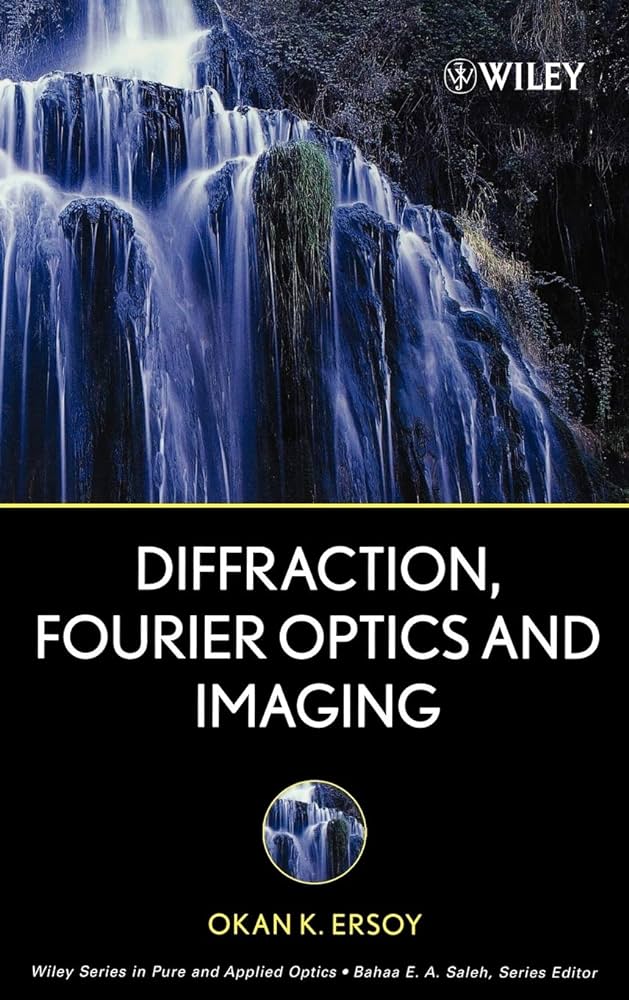
Descripción
Estudio integral de los principios fundamentales que vinculan la teoría ondulatoria de la luz con las aplicaciones modernas en óptica, procesamiento de señales e imágenes. Esta obra ofrece una base teórica rigurosa y detallada en difracción, transformadas de Fourier y óptica coherente, proporcionando las herramientas necesarias para comprender fenómenos ópticos complejos y diseñar sistemas de imagen avanzados.
Okan K. Ersoy, reconocido por sus contribuciones en el campo del procesamiento óptico y digital, presenta el contenido con un enfoque matemático preciso, sin dejar de lado la claridad conceptual. Se exploran en profundidad las bases físicas de la propagación de ondas, la teoría de difracción de Fresnel y Fraunhofer, el análisis espectral mediante transformadas de Fourier y su aplicación directa en óptica y formación de imágenes. Cada capítulo conecta los fundamentos teóricos con aplicaciones prácticas en áreas como microscopía, holografía, óptica computacional, sistemas de visión artificial y tecnologías de imagen médica.
Se incluyen numerosos ejemplos, problemas resueltos y ejercicios que refuerzan el aprendizaje y permiten aplicar el conocimiento en contextos reales de investigación o desarrollo tecnológico. Recomendado para estudiantes avanzados de física, ingeniería óptica, ciencias aplicadas y disciplinas afines, así como para investigadores y profesionales que trabajan en diseño de sistemas ópticos, procesamiento de señales e imagenología. Más que una referencia técnica, constituye una guía profunda para comprender cómo la luz puede ser manipulada, transformada y utilizada para revelar estructuras invisibles y representar el mundo con precisión científica.
Preface
1. Diffraction, Fourier Optics and Imaging
1.1 Introduction
1.2 Examples of Emerging Applications with Growing Significance
1.2.1 Dense Wavelength Division Multiplexing/Demultiplexing (DWDM)
1.2.2 Optical and Microwave DWDM Systems
1.2.3 Diffractive and Subwavelength Optical Elements
1.2.4 Nanodiffractive Devices and Rigorous Diffraction Theory
1.2.5 Modern Imaging Techniques
2. Linear Systems and Transforms
2.1 Introduction
2.2 Linear Systems and Shift Invariance
2.3 Continuous-Space Fourier Transform
2.4 Existence of Fourier Transform
2.5 Properties of the Fourier Transform
2.6 Real Fourier Transform
2.7 Amplitude and Phase Spectra
2.8 Hankel Transforms
3. Fundamentals of Wave Propagation
3.1 Introduction
3.2 Waves
3.3 Electromagnetic Waves
3.4 Phasor Representation
3.5 Wave Equations in a Charge-Free Medium
3.6 Wave Equations in Phasor Representation in a Charge-Free Medium
3.7 Plane EM Waves
4. Scalar Diffraction Theory
4.1 Introduction
4.2 Helmholtz Equation
4.3 Angular Spectrum of Plane Waves
4.4 Fast Fourier Transform (FFT) Implementation
4.5 The Kirchoff Theory of Diffraction
4.5.1 Kirchoff Theory of Diffraction
4.5.2 Fresnel-Kirchoff Diffraction Formula
4.6 The Rayleigh-Sommerfeld Theory of Diffraction
4.6.1 The Kirchhoff Approximation
4.6.2 Second Rayleigh-Sommerfeld Diffraction Formula
4.7 Another Derivation of Rayleigh-Sommerfeld Diffraction
4.8 Diffraction Integral For Nonmonochromatic Waves
5. Fresnel and Fraunhofer Approximations
5.1 Introduction
5.2 Diffraction in the Fresnel Region
5.3 FFT Implementation
5.4 Paraxial Wave Equation
5.5 Diffraction in the Fraunhofer Region
5.6 Diffraction Gratings
5.7 Fraunhofer Diffraction by Sinusoidal Amplitude Grating
5.8 Fresnel Diffraction by Sinusoidal Amplitude Grating
5.9 Fraunhofer Diffraction with Sinusoidal Phase Grating
5.10 Diffraction Gratings Made of Slits
6. Inverse Diffraction
6.1 Introduction
6.2 Inversion of Fresnel and Fraunhofer Representations
6.3 Inversion of Angular Spectrum Representation
6.4 Analysis
7. Wide-Angle Near and Far Field Approximations
7.1 Introduction
7.2 Review of Fresnel and Fraunhofer Approximations
7.3 The Radial Set of Approximations
7.4 Higher Order Improvements and Analysis
7.5 Inverse Diffraction and Iterative Optimization
7.6 Numerical Examples
7.7 More Accurate Approximations
7.8 Conclusions
8. Geometrical Optics
8.1 Introduction
8.2 Propagation of Rays
8.3 The Ray Equations
8.4 The Eikonal Equation
8.5 Local Spatial Frequencies and Rays
8.6 Matrix Representation of Meridional Rays
8.7 Thick Lenses
8.8 Entrance and Exit Pupils
9. Fourier Transforms and Imaging with Coherent Optical Systems
9.1 Introduction
9.2 Phase Transformation with a Thin Lens
9.3 Fourier Transforms with Lenses
9.3.1 Wave Field Incident on the Lens
9.3.2 Wave Field to the Left of the Lens
9.3.3 Wave Field to the Right of the Lens
9.4 Image Formation as 2-D Linear Filtering
9.4.1 Effect of Finite Lens Aperture
9.5 Phase Contrast Microscopy
9.6 Scanning Confocal Microscopy
9.6.1 Image Formation
9.7 Operator Algebra for Complex Systems
10. Imaging with Quasi-Monochromatic Waves
10.1 Introduction
10.2 Hilbert Transform
10.3 Analytic Signal
10.4 Representation of Nonmonochromatic Wave Field
10.5 Coherent and Incoherent Waves
10.6 Diffraction Effects in Imaging Systems
10.7 Imaging with Quasi-Monochromatic Waves
10.7.1 Coherent Imaging
10.7.2 Incoherent Imaging
10.8 Frequency Response of Imaging Systems
10.8.1 Coherent Imaging System
10.8.2 Incoherent Imaging System
10.9 Optical Transfer Function Computation
10.9.1 Practical Considerations
10.10 Aberrations
10.10.1 Zernike Polynomials
11. Optical Devices Based on Wave Modulation
11.1 Introduction
11.2 Photographic Films and Plates
11.3 Transmittance of Light by Film
11.4 Modulation Transfer Function
11.5 Bleaching
11.6 Diffractive, Binary, and Digital Optics
11.7 E-Beam Lithography
11.7.1 DOE Implementation
12. Wave Propagation in Inhomogeneous Media
12.1 Introduction
12.2 Helmholtz Equation
12.3 Paraxial Wave Equation
12.4 Beam Propagation Method
12.4.1 Propagation in Medium with Index n
12.4.2 Virtual Lens Effect
12.5 Propagation in Directional Coupler
12.5.1 Coupled Mode Theory
12.5.2 Comparison with BPM
13. Holography
13.1 Introduction
13.2 Coherent Wave Front Recording
13.2.1 LeithUpatnieks Hologram
13.3 Types of Holograms
13.3.1 Fresnel and Fraunhofer
13.3.2 Image and Fourier
13.3.3 Volume
13.3.4 Embossed
13.4 Simulation of Reconstruction
13.5 Holographic Imaging and Magnification
13.6 Aberrations
14. Apodization, Superresolution, and Information Recovery
14.1 Introduction
14.2 Apodization
14.2.1 Discrete-Time Windows
14.3 Two-Point Resolution
14.4 Contractions
14.4.1 Contraction Mapping Theorem
14.5 Iterative Signal Recovery
14.6 Constrained Deconvolution
14.7 Method of Projections
14.8 Projections onto Convex Sets
14.9 GerchbergPapoulis Algorithm
14.10 Other POCS Algorithms
14.11 Restoration from Phase
14.12 Reconstruction Using DFT
14.13 Generalized Projections
14.14 Restoration from Magnitude
14.14.1 Traps and Tunnels
14.15 Least Squares and Generalized Inverse
14.16 SVD for H?
14.17 Steepest Descent Algorithm
14.18 Conjugate Gradient Method
15. Diffractive Optics I
15.1 Introduction
15.2 Lohmann Method
15.3 Approximations
15.4 Constant Amplitude
15.5 Quantized Method
15.6 Simulations
15.7 Fourier Method with Hard-Clipping
15.8 Algorithm for 3-D Point Images
15.8.1 Experiments
15.9 Fast Weighted Zero-Crossing Algorithm
15.9.1 Off-Axis Reference Wave
15.9.2 Experiments
15.10 One-Image-Only Holography
15.10.1 Image Formation
15.10.2 Experiments
15.11 Fresnel Zone Plates
16. Diffractive Optics II
16.1 Introduction
16.2 Virtual Holography
16.2.1 Phase Determination
16.2.2 Aperture Effects
16.2.3 Image Formation
16.2.4 Information Capacity
16.2.5 Volume Effects
16.2.6 Wavelength and Size Changes
16.2.7 Experiments
16.3 POCS for Binary DOE Design
16.4 Iterative Interlacing Technique (IIT)
16.4.1 Experiments
16.5 ODIFIIT
16.5.1 Experiments
16.6 Lohmann-ODIFIIT Method
16.6.1 Computer Experiments
17. Computerized Imaging I: Synthetic Aperture Radar
17.1 Introduction
17.2 Synthetic Aperture Radar
17.3 Range Resolution
17.4 Pulse Waveform Choice
17.5 Matched Filter
17.6 Pulse Compression
17.7 Cross-Range Resolution
17.8 SAR Imaging Theory
17.9 Reconstruction with Fresnel Approximation
17.10 Digital Image Reconstruction Algorithms
17.10.1 Frequency Interpolation
18. Computerized Imaging II: Reconstruction from Projections
18.1 Introduction
18.2 Radon Transform
18.3 Projection Slice Theorem
18.4 Inverse Radon Transform
18.5 Radon Transform Properties
18.6 Signal Reconstruction
18.7 Fourier Reconstruction
18.8 Filtered-Backprojection
19. Dense Wavelength Division Multiplexing
19.1 Introduction
19.2 Array Waveguide Grating
19.3 MISZC Method
19.3.1 Correction Terms
19.3.2 Extension to 3-D
19.4 MISZC Analysis
19.4.1 Dispersion Analysis
19.4.2 Finite Apertures
19.5 Computer Experiments
19.5.1 Point-Source Apertures
19.5.2 Large Channel Count
19.5.3 Finite Apertures
19.5.4 Negative Phase Creation
19.5.5 Error Tolerances
19.5.6 3-D Simulations
19.5.7 Phase Quantization
19.6 Implementation
20. Numerical Methods for Rigorous Diffraction Theory
20.1 Introduction
20.2 BPM with Finite Differences
20.3 Wide Angle BPM
20.4 Finite Differences
20.5 FDTD Method
20.5.1 Yee's Algorithm
20.6 Computer Experiments
20.7 Fourier Modal Methods
Appendices
A. The Impulse Function
B. Linear Vector Spaces
C. Discrete-Time FT, DFT, and FFT
References
Index
Consulta los datos bibliográficos de esta edición para identificar correctamente el recurso, revisar su autoría y verificar detalles como ISBN, tema, subtema, archivo e idioma.
- Título: Diffraction. Fourier Optics and Imaging
- Autor/es: Okan K. Ersoy
- Edición: 1ra Edición
- Año de publicación: 2007
- Tipo de archivo: eBook
- Idioma: eBook en Inglés
- Editorial: Wiley-Interscience
- Páginas: 413
- ISBN-13: 9780471238164
- Subtema: Óptica
Citar este libro
Preparando citaciones...




Aún no hay comentarios
Sé el primero en compartir tu opinión sobre este contenido.
Escribir un comentario