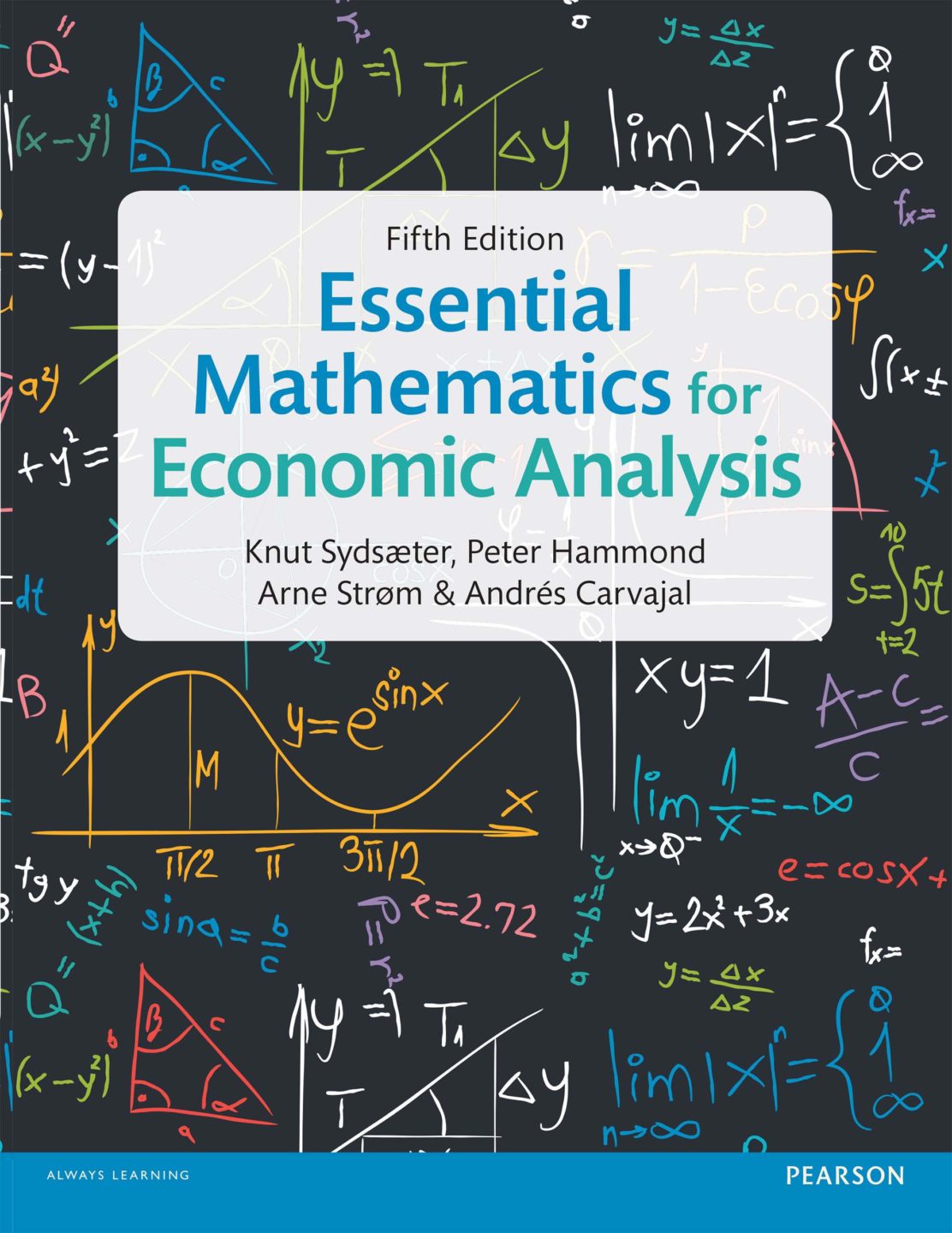
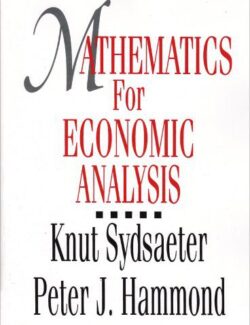
Essential Mathematics for Economic Analysis – Knut Sydsaeter – 5th Edition
Descripción
En este bestseller mundial se ofrece una amplia introducción a todas las herramientas matemáticas que necesita un economista. El libro aborda una amplia gama de conceptos matemáticos que son fundamentales para la comprensión y el análisis de cuestiones económicas.
El libro es apreciado por su enfoque en aplicar las matemáticas a problemas económicos y sociales, lo que lo convierte en una herramienta valiosa para estudiantes y profesionales que desean mejorar sus habilidades matemáticas para el análisis económico. Es especialmente útil para aquellos que estudian economía, finanzas, ciencias sociales y áreas relacionadas.
Novedades de esta edición:
– Los capítulos introductorios se han reestructurado para que se ajusten más lógicamente a la enseñanza.
– Se han introducido varios ejercicios nuevos, así como soluciones más completas a los ya existentes.
– Se ha añadido más cobertura de la historia de las ideas matemáticas y económicas, así como de los científicos que las desarrollaron.
– Nuevo ejemplo basado en la reforma de la fiscalidad de la vivienda en el Reino Unido de 2014 que ilustra cómo una función discontinua puede tener importantes consecuencias económicas.
Chapter 01: Essentials of Logic and Set Theory
1.1. Essentials of set theory
1.2. Some aspects of logic
1.3. Mathematical proofs
1.4. Mathematical induction
Chapter 02: Algebra
2.1. The real numbers
2.2. Integer powers
2.3. Rules of algebra
2.4. Fractions
2.5. Fractional powers
2.6. Inequalities
2.7. Intervals and absolute values
2.8. Summation
2.9. Rules for sums
2. 10. Newton's binomial formula
2. 11. Double sums
Chapter 03: Solving Equations
3.1. Solving equations
3.2. Equations and their parameters
3.3. Quadratic equations
3.4. Nonlinear equations
3.5. Using implication arrows
3.6. Two linear equations in two unknowns
Chapter 04: Functions of One Variable
4.1. Introduction
4.2. Basic definitions
4.3. Graphs of functions
4.4. Linear functions
4.5. Linear models
4.6. Quadratic functions
4.7. Polynomials
4.8. Power functions
4.9. Exponential functions
4. 10. Logarithmic functions
Chapter 05: Properties of Functions
5.1. Shifting graphs
5.2. New functions from old
5.3. Inverse functions
5.4. Graphs of equations
5.5. Distance in the plane
5.6. General functions
Chapter 06: Differentiation
6.1. Slopes of curves
6.2. Tangents and derivatives
6.3. Increasing and decreasing functions
6.4. Rates of change
6.5. A dash of limits
6.6. Simple rules for differentiation
6.7. Sums, products and quotients
6.8. The Chapter ain Rule
6.9. Higher-order derivatives
6. 10. Exponential functions
6. 11. Logarithmic functions
Chapter 07: Derivatives in Use
7.1. Implicit differentiation
7.2. Economic examples
7.3. Differentiating the inverse
7.4. Linear approximations
7.5. Polynomial approximations
7.6. Taylor's formula
7.7. Elasticities
7.8. Continuity
7.9. More on limits
7. 10. The intermediate value theorem and Newton's method
7. 11. Infinite sequences
7. 12. L'Hôpital's Rule
Chapter 08: Single-Variable Optimization
8.1. Extreme points
8.2. Simple tests for extreme points
8.3. Economic examples
8.4. The Extreme Value Theorem
8.5. Further economic examples
8.6. Local extreme points
8.7. Inflection points
Chapter 09: Integration
9.1. Indefinite integrals
9.2. Area and definite integrals
9.3. Properties of definite integrals
9.4. Economic applications
9.5. Integration by parts
9.6. Integration by substitution
9.7. Infinite intervals of integration
9.8. A glimpse at differential equations
9.9. Separable and linear differential equations
Chapter 10: Topics in Financial Mathematics
10.1. Interest periods and effective rates
10.2. Continuous compounding
10.3. Present value
10.4. Geometric series
10.5. Total present value
10.6. Mortgage repayments
10.7. Internal rate of return
10.8. A glimpse at difference equations
Chapter 11: Functions of Many Variables
11.1. Functions of two variables
11.2. Partial derivatives with two variables
11.3. Geometric representation
11.4. Surfaces and distance
11.5. Functions of more variables
11.6. Partial derivatives with more variables
11.7. Economic applications
11.8. Partial elasticities
Chapter 12: Tools for Comparative Statics
12.1. A simple chain rule
12.2. Chain rules for many variables
12.3. Implicit differentiation along a level curve
12.4. More general cases
12.5. Elasticity of substitution
12.6. Homogeneous functions of two variables
12.7. Homogeneous and homothetic functions
12.8. Linear approximations
12.9. Differentials
12. 10. Systems of equations
12. 11. Differentiating systems of equations
Chapter 13: Multivariable Optimization
13.1. Two variables: necessary conditions
13.2. Two variables: sufficient conditions
13.3. Local extreme points
13.4. Linear models with quadratic objectives
13.5. The Extreme Value Theorem
13.6. The general case
13.7. Comparative statics and the envelope theorem
Chapter 14: Constrained Optimization
14.1. The Lagrange Multiplier Method
14.2. Interpreting the Lagrange multiplier
14.3. Multiple solution candidates
14.4. Why the Lagrange method works
14.5. Sufficient conditions
14.6. Additional variables and constraints
14.7. Comparative statics
14.8. Nonlinear programming: a simple case
14.9. Multiple inequality constraints
14. 10. Nonnegativity constraints
Chapter 15: Matrix and Vector Algebra
15.1. Systems of linear equations
15.2. Matrices and matrix operations
15.3. Matrix multiplication
15.4. Rules for matrix multiplication
15.5. The transpose
15.6. Gaussian elimination
15.7. Vectors
15.8. Geometric interpretation of vectors
15.9. Lines and planes
Chapter 16: Determinants and Inverse Matrices
16.1. Determinants of order 2
16.2. Determinants of order 3
16.3. Determinants in general
16.4. Basic rules for determinants
16.5. Expansion by cofactors
16.6. The inverse of a matrix
16.7. A general formula for the inverse
16.8. Cramer's Rule
16.9. The Leontief Model
Chapter 17: Linear Programming
17.1. A graphical approach
17.2. Introduction to Duality Theory
17.3. The Duality Theorem
17.4. A general economic interpretation
17.5. Complementary slackness
Consulta los datos bibliográficos de esta edición para identificar correctamente el recurso, revisar su autoría y verificar detalles como ISBN, tema, subtema, archivo e idioma.
- Título: Essential Mathematics for Economic Analysis
- Autor/es: Knut Sydsaeter | Andrés M. Carvajal | Arne Strøm | Peter J. Hammond
- Edición: 5ta Edición
- Año de publicación: 2016
- Tipo de archivo: eBook | Solucionario
- Idioma: eBook en Inglés
- Editorial: imusti
- Páginas: 832
- ISBN-10: 1292074612
- ISBN-13: 9781292074610
- Subtema: Matemáticas Financieras
Citar este libro
Preparando citaciones...












Aún no hay comentarios
Sé el primero en compartir tu opinión sobre este contenido.
Escribir un comentario