Finite Mathematics for the Managerial, Life, and Social Sciences – Soo T. Tan – 8th Edition
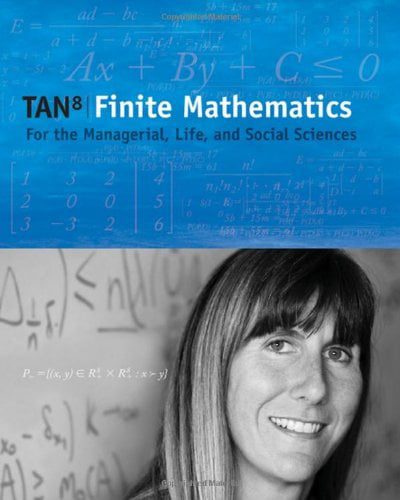
Descripción
Líder del mercado en la matemáticas finitas para la gestión, aplicaciones de la vida, y las ciencias sociales, Soo T. Tan ofrece una presentación precisa y accesible e las matemáticas finitas combinado con el equilibro juso de las aplicaciones, la pedagogía y la tecnología para ayudar a los estudiantes a tener éxito en el curso.
La octava edición incluye las aplicaciones actuales de gran interés y ejercicios de Microsoft Excel para ayudar a estimular la motivación del estudiante. Una nueva y excitante gama de suplementospara motivar el desarrollo de destrezas, además proporciona a los estudiantes un amplio soporte de aprendizaje con instructores para la resolución de los ejercicios.
PREFACE.
1. Straight Lines and Linear Functions.
The Cartesian Coordinate System. Straight Lines. Using Technology: Graphing a Straight Line. Linear Functions and Mathematical Models. Using Technology: Evaluating a Function. Intersection of Straight Lines. Using Technology: Finding the Point(s) of Intersection of Two Graphs. The Method of Least Squares.
Portfolio. Using Technology: Finding an Equation of a Least-Squares Line. Chapter 1 Summary of Principal Formulas and Terms. Chapter 1 Concept Review Questions. Chapter 1 Review Exercises. Chapter 1 Before Moving On.
2. SYSTEMS OF LINEAR EQUATIONS AND MATRICES.
Systems of Linear Equations: An Introduction. Systems of Linear Equations: Unique Solutions. Using Technology: Systems of Linear Equations: Unique Solutions. Systems of Linear Equations: Underdetermined and Overdetermined Systems. Using Technology: Systems of Linear Equations: Underdetermined and Overdetermined Systems. Matrices. Using Technology: Matrix Operations. Multiplication of Matrices. Using Technology: Matrix Multiplication. The Inverse of a Square Matrix. Using Technology: Finding the Inverse of a Square Matrix. Leontief Input—Output Model. Using Technology: The Leontief Input—Output Model. Chapter 2 Summary of Principal Formulas and Terms. Chapter 2 Concept Review Questions. Chapter 2 Review Exercises. Chapter 2 Before Moving On.
3. LINEAR PROGRAMMING: A GEOMETRIC APPROACH.
Graphing Systems of Linear Inequalities in Two Variables. Linear Programming Problems. Graphical Solutions of Linear Programming Problems. Sensitivity Analysis. Chapter 3 Summary of Principal Formulas and Terms. Chapter 3 Concept Review Questions. Chapter 3 Review Exercises. Chapter 3 Before Moving On.
4. LINEAR PROGRAMMING: AN ALGEBRAIC APPROACH.
The Simplex Method: Standard Maximization Problems. Portfolio. Using Technology: The Simplex Method: Solving Maximization Problems. The Simplex Method: Standard Minimization Problems. Using Technology: The Simplex Method: Solving Minimization Problems. The Simplex Method: Nonstandard Problems. Chapter 4 Summary of Principal Formulas and Terms. Chapter 4 Concept Review Questions. Chapter 4 Review Exercises. Chapter 4 Before Moving On.
5. MATHEMATICS OF FINANCE.
Compound Interest. Using Technology: Finding the Accumulated Amount of an Investment, the Effective Rate of Interest, and the Present Value of an Investment. Annuities. Using Technology: Finding the Amount of an Annuity. Amortization and Sinking Funds. Using Technology: Amortizing a Loan. Arithmetic and Geometric Progressions. Chapter 5 Summary of Principal Formulas and Terms. Chapter 5 Concept Review Questions. Chapter 5 Review Exercises. Chapter 5 Before Moving On.
5. SETS AND COUNTING.
Sets and Set Operations. The Number of Elements in a Finite Set. The Multiplication Principle. Permutations and Combinations. Portfolio. Using Technology: Evaluating n!, P (n,r) and C (n,r). Chapter 6 Summary of Principal Formulas and Terms. Chapter 6 Concept Review Questions. Chapter 6 Review Exercises. Chapter 6 Before Moving On.
7. PROBABILITY.
Experiments, Sample Spaces, and Events. Definition of Probability. Rules of Probability. Use of Counting Techniques in Probability. Conditional Probability and Independent Events. Bayes' Theorem. Chapter 7 Summary of Principal Formulas and Terms. Chapter 7 Concept Review Questions. Chapter 7 Review Exercises. Chapter 7 Before Moving On.
8. PROBABILITY DISTRIBUTIONS AND STATISTICS.
Distributions of Random Variables. Using Technology: Graphing a Histogram. Expected Value. Portfolio. Variance and Standard Deviation. Using Technology: Finding the Mean and Standard Deviation. The Binomial Distribution. The Normal Distribution. Applications of the Normal Distribution. Chapter 8 Summary of Principal Formulas and Terms. Chapter 8 Concept Review Questions. Chapter 8 Review Exercises. Chapter 8 Before Moving On.
9. MARKOV CHAINS AND THE THEORY OF GAMES.
Markov Chains. Using Technology: Finding Distribution Vectors. Regular Markov Chains. Using Technology: Finding the Long-term Distribution Vector. Absorbing Markov Chains. Game Theory and Strictly Determined Games. Portfolio. Games with Mixed Strategies. Chapter 9 Summary of Principal Formulas and Terms. Chapter 9 Concept Review Questions. Chapter 9 Review Exercises. Chapter 9 Before Moving On.
Appendix A: Introduction to Logic.
Propositions and Connectives. Truth Tables. The Conditional and the Biconditional Connectives. Laws of Logic. Arguments. Applications of Logic to Switching Networks.
Appendix B: The System of Real Numbers.
Appendix C: A Review of Logarithms.
Appendix D: Tables.
Table 1: Binomial Probabilities.
Table 2: The Standard Normal Distribution.
Answers to Odd-Numbered Exercises.
Index.
Consulta los datos bibliográficos de esta edición para identificar correctamente el recurso, revisar su autoría y verificar detalles como ISBN, tema, subtema, archivo e idioma.
- Título: Finite Mathematics for the Managerial; Life and Social Sciences
- Autor/es: Soo T. Tan
- Edición: 8va Edición
- Año de publicación: 2006
- Tipo de archivo: eBook
- Idioma: eBook en Inglés
- Editorial: Thomson Brooks/Cole
- Páginas: 646
- ISBN-10: 0534492142
- ISBN-13: 9780534492144
- Subtema: Matemáticas Aplicadas
Citar este libro
Preparando citaciones...




gracias por compartir un excelente libro de matemáticas