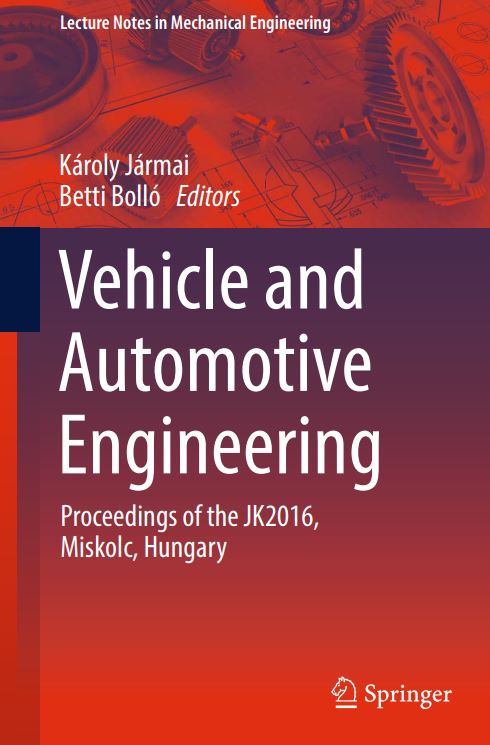
Vehicle and Automotive Engineering: Proceedings of the VEA 2016, Miskolc, Hungary – Károly Jármai, Betti Bolló – 1st Edition
Descripción
Este volumen reúne las actas del congreso JK2016 (celebrado en octubre de 2016 en la University of Miskolc, Miskolc, Hungría) centradas en la ingeniería de vehículos y de la automoción. Su objetivo es presentar tanto estudios teóricos como prácticos que abordan el futuro del diseño automotriz, la fabricación, la economía del vehículo, la educación técnica y la industria automotriz. La obra está dirigida a estudiantes universitarios, investigadores y profesionales jóvenes interesados en automoción, materiales, procesos de fabricación, sistema vehículo-automóvil, movilidad y enseñanza técnica.
El lector encontrará una colección de trabajos diversos que van desde temas de diseño de elementos estructurales (como rodamiento, radiador de automóvil, chasis, estructura de cama de camión) hasta manufactura avanzada (soldadura de aceros de alta resistencia, fatiga, recubrimientos, soldadura por resistencia en aluminio), tecnología de materiales (análisis de topografía de aluminio, reciclaje de neumáticos, conversión catalítica de residuos hidrocarburados), electrónica y automoción (sistemas autónomos, sensorless de generador automotriz, CAN-Bus para vehículo autónomo), logística y economía industrial (programación de producción, planificación de piezas, seguridad del stock, redes logísticas) y también educación (enseñanza e investigación en motores de combustión interna, dual training).
Por lo tanto, el texto ofrece tanto amplitud como aplicabilidad. Para un estudiante universitario, esta publicación permite: 1) familiarizarse con los desafíos reales de la automoción contemporánea, desde el material, la estructura, la fabricación, la electrónica hasta la logística y educación técnica; 2) encontrar ejemplos de investigación aplicada presentados en un entorno internacional; 3) usarlo como referencia para trabajos de fin de grado, máster o investigación que requieren estudios de casos, referencias de artículos de congreso, o exploración de temas emergentes (vehículos autónomos, soldadura avanzada, reciclaje de neumáticos, sensores en vehículos).
Aunque no es un texto de aula convencional, su valor radica en mostrar la vanguardia de la investigación en automoción desde múltiples frentes. Además, al estar editado como actas de congreso, es útil para desarrollar una mentalidad de investigador: comparar metodologías, ver qué estudios se llevan a cabo, cuál es el estado del arte (o lo que en 2016 lo era), y reflexionar sobre cómo esos trabajos podrían evolucionar. Al lector joven se le invita no solo a leer, sino a pensar ¿y qué queda por hacer?, ¿cómo mi trabajo podría contribuir?, ¿qué técnicas, materiales o sistemas podrían mejorarse?. También es una buena introducción a la cultura de las conferencias internacionales en automoción. En resumen, Vehicle and Automotive Engineering es una obra de referencia para quien quiera adentrarse más allá de los manuales tradicionales de ingeniería automotriz, y obtener una visión panorámica sobre los procesos industriales, el diseño, los materiales, la fabricación, la electrónica, la logística y la enseñanza en automoción.
1. Investigation of Rolling Element Bearings Using Time Domain Features
2. Truck Floor Design for Minimum Mass and Cost Using Different Materials
3. Theoretical and Parametric Investigation of an Automobile Radiator
4. Teaching and Research in Vehicle Engines at the University of Miskolc
5. Alternating Current Hydraulic Drive: The Possibility of Applying in the Automotive Industry
6. Comparative Destructive and Non-Destructive Residual Stress Measuring Methods for Steering Rack Bar Semi-Product
7. Dynamical Modelling of Vehicles Maneuvering
8. Developing a Rotary Internal Combustion Engine Characterised by High Speed Operation
9. Simulation Methods in Vehicle Noise, Vibration and Harshness (NVH)
10. Optimal Damping of Random Excited Systems
11. Application of Knowledge-Based Design in Computer-Aided Product Development
12. Elementary Calculations for Deflection of Circular Rings
13. Position- and Speed-Dependent Power-Absorbing Hydraulic Cylinder with Mathematically Predictable Characteristics
Technology
14. Utilization of the GD-OES Depth Profiling Technique in Automotive Parts Analysis
15. Analysis of Surface Topography of Diamond-Burnished Aluminium Alloy Components
16. Investigation of Tyre Recycling Possibilities with Cracking Process
17. Utilisation of Various Hydrocarbon-Based Wastes by Thermocatalytic Conversion
18. Development of Nitrided Selective Wave Soldering Tool with Enhanced Lifetime for the Automotive Industry
19. The Effect of Tensile Strength on the Formability Parameters of Dual Phase Steels
20. Comparison of Two Laser Interferometric Methods for the Study of Vibrations
21. Deburring of Polymer and Metal Matrix Composites
22. The Past, Present and Future of the Training of Internal Combustion Engines at the Department of Energy Engineering of BME
23. Concept of a New Method for Helical Surface Machining on Lathe
Electrotechnics / Informatics
24. Intelligent Transportation Systems to Support Production Logistics
25. A New Scheduling Software for Supporting Automotive Component Manufacturing
26. The Context Between the Shift of Average Demand and the Safety Stock of Purchased Parts
27. An Overview of Autonomous Intelligent Vehicle Systems
28. Software Reliability of Complex Systems: Focus for Intelligent Vehicles
29. Usage of an Optical Flow Sensor in Robotics to Define Orientation
30. Pose Determination for Autonomous Vehicle Control
31. Description of a Method for the Handling of Customer Needs in Logistics
32. Sensorless Determination of Load Current of an Automotive Generator Applying Neuro-Fuzzy Methods
33. Distributed CAN-Bus-Based Driving Assistance System on Autonomous Vehicle
34. Wall and Object Detection with FRI and Bayes Classifier for Autonomous Robot
35. Optimal Formation of Logistics Networks
Welding
36. Development of Complex Spot Welding Technologies for Automotive DP Steels with FEM Support
37. A Lightweight Design Approach for Welded Railway Vehicle Structures of Modern Passenger Coach
38. Challenges and Solutions in Resistance Welding of Aluminium Alloys: Dealing with Non-Predictable Conditions
39. High Cycle Fatigue Investigations on High Strength Steels and Their GMA Welded Joints
40. Toughness Examination of Physically Simulated S960QL HAZ by a Special Drilled Specimen
41. Innovation Methods for Residual Stress Determination for the Automotive Industry
Author Index
Página de créditos
Consulta los datos bibliográficos de esta edición para identificar correctamente el recurso, revisar su autoría y verificar detalles como ISBN, tema, subtema, archivo e idioma.
- Título: Vehicle and Automotive Engineering: Proceedings of the VEA 2016. Miskolc. Hungary
- Autor/es: Károly Jármai | Betti Bolló
- Edición: 1ra Edición
- Año de publicación: 2017
- Tipo de archivo: eBook
- Idioma: eBook en Inglés
- ISBN-13: 9783319511894
- Subtema: Ingeniería Automotriz
Citar este libro
Preparando citaciones...

Aún no hay comentarios
Sé el primero en compartir tu opinión sobre este contenido.
Escribir un comentario