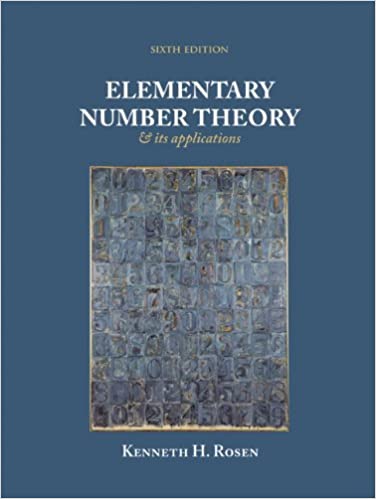
Elementary Number Theory and its Applications – Kenneth Rosen – 6th Edition
Descripción
Elementary Number Theory, sexta edición, combina la teoría clásica con aplicaciones modernas y se destaca por sus excelentes conjuntos de ejercicios. Una gama completa de ejercicios, desde básicos hasta desafiantes, ayuda a los lectores a explorar conceptos clave y llevar su comprensión a nuevas alturas. También se encuentran disponibles ejercicios computacionales y proyectos informáticos.
Como reflejo de muchos años de comentarios de los profesores, esta edición ofrece nuevos ejemplos, ejercicios y aplicaciones, al tiempo que incorpora avances y descubrimientos en teoría de números realizados en los últimos años.
Chapter 1. The Integers
1.1. Numbers and Sequences
1.2. Sums and Products
1.3. Mathematical Induction
1.4. The Fibonacci Numbers
1.5. Divisibility
Chapter 2. Integer Representations and Operations
2.1. Representations of Integers
2.2. Computer Operations with Integers
2.3. Complexity and Integer Operations
Chapter 3. Primes and Greatest Common Divisors
3.1. Prime Numbers
3.2. The Distribution of Primes
3.3. Greatest Common Divisors and their Properties
3.4. The Euclidean Algorithm
3.5. The Fundamental Theorem of Arithmetic
3.6. Factorization Methods and the Fermat Numbers
3.7. Linear Diophantine Equations
Chapter 4. Congruences
4.1. Introduction to Congruences
4.2. Linear Congruences
4.3. The Chinese Remainder Theorem
4.4. Solving Polynomial Congruences
4.5. Systems of Linear Congruences
4.6. Factoring Using the Pollard Rho Method
Chapter 5. Applications of Congruences
5.1. Divisibility Tests
5.2. The Perpetual Calendar
5.3. Round-Robin Tournaments
5.4. Hashing Functions
5.5. Check Digits
Chapter 6. Some Special Congruences
6.1. Wilson's Theorem and Fermat's Little Theorem
6.2. Pseudoprimes
6.3. Euler's Theorem
Chapter 7. Multiplicative Functions
7.1. The Euler Phi-Function
7.2. The Sum and Number of Divisors
7.3. Perfect Numbers and Mersenne Primes
7.4. Mobius Inversion
7.5. Partitions
Chapter 8. Cryptology
8.1. Character Ciphers
8.2. Block and Stream Ciphers
8.3. Exponentiation Ciphers
8.4. Public Key Cryptography
8.5. Knapsack Ciphers
8.6. Cryptographic Protocols and Applications
Chapter 9. Primitive Roots
9.1. The Order of an Integer and Primitive Roots
9.2. Primitive Roots for Primes
9.3. The Existence of Primitive Roots
9.4. Discrete Logarithms and Index Arithmetic
9.5. Primality Tests Using Orders of Integers and Primitive Roots
9.6. Universal Exponents
Chapter 10. Applications of Primitive Roots and the Order of an Integer
10.1. Pseudorandom Numbers
10.2. The ElGamal Cryptosystem
10.3. An Application to the Splicing of Telephone Cables
Chapter 11. Quadratic Residues
11.1. Quadratic Residues and Nonresidues
11.2. The Law of Quadratic Reciprocity
11.3. The Jacobi Symbol
11.4. Euler Pseudoprimes
11.5. Zero-Knowledge Proofs
Chapter 12. Decimal Fractions and Continued Fractions
12.1. Decimal Fractions
12.2. Finite Continued Fractions
12.3. Infinite Continued Fractions
12.4. Periodic Continued Fractions
12.5. Factoring Using Continued Fractions
Chapter 13. Some Nonlinear Diophantine Equations
13.1. Pythagorean Triples
13.2. Fermat's Last Theorem
13.3. Sums of Squares
13.4. Pell's Equation
13.5. Congruent Numbers
Chapter 14. The Gaussian Integers
14.1. Gaussian Integers and Gaussian Primes
14.2. Greatest Common Divisors and Unique Factorization
14.3. Gaussian Integers and Sums of Squares
Appendix A. Axioms for the Set of Integers
Appendix B. Binomial Coefficients
Consulta los datos bibliográficos de esta edición para identificar correctamente el recurso, revisar su autoría y verificar detalles como ISBN, tema, subtema, archivo e idioma.
- Título: Elementary Number Theory and its Applications
- Autor/es: Kenneth Rosen
- Edición: 6ta Edición
- Año de publicación: 2011
- Tipo de archivo: eBook
- Idioma: eBook en Inglés
- Editorial: Pearson Addison-Wesley
- ISBN-10: 0321500318
- ISBN-13: 9780321500311
- Subtema: Análisis Numérico
Citar este libro
Preparando citaciones...








Aún no hay comentarios
Sé el primero en compartir tu opinión sobre este contenido.
Escribir un comentario